


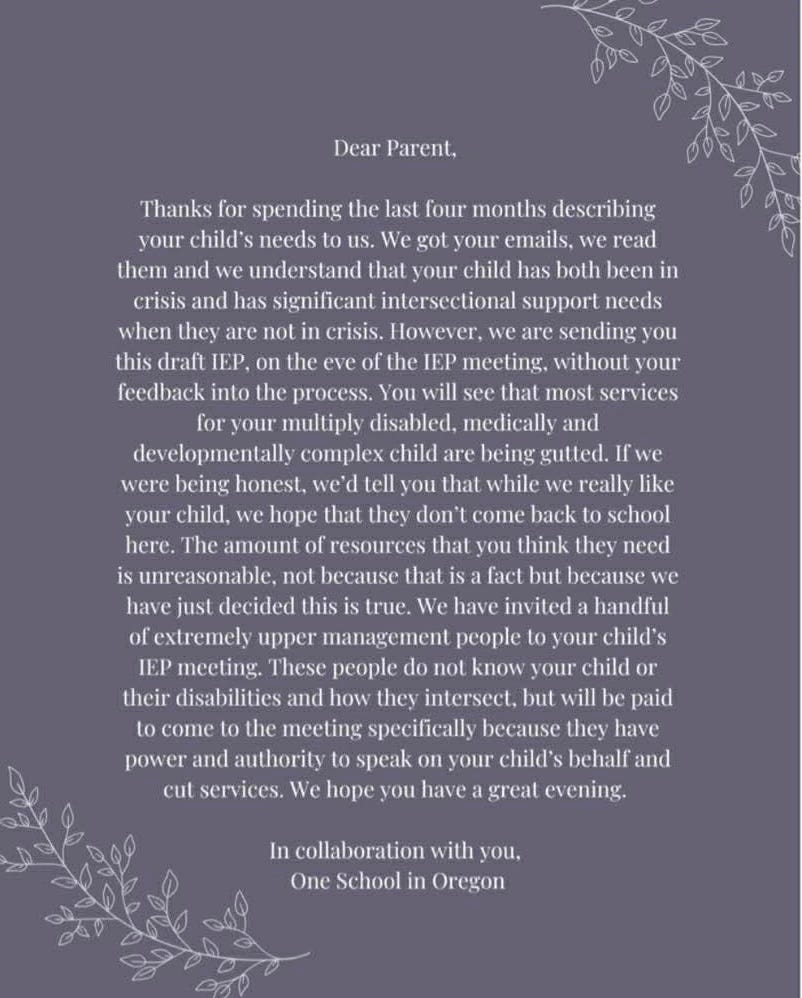
A Medical Motherhood reader who would like to remain anonymous submitted this poem after a particularly brutal IEP meeting — the Individualized Education Plan meeting that is supposed to determine supports for disabled children at school. The Individuals with Disabilities Education Act or IDEA created this team approach. When it works well, parents, teachers, specialists and administrators — and hopefully the child themselves — work together to come up with a plan for how the student can access their civil right to a free and appropriate public education.
When it doesn’t… it becomes a pressure cooker for deep-seated resentments and systemic ableism.
How have your experiences with IEP meetings gone?
Medical Motherhood’s news round up
Snippets of news and opinion from outlets around the world. Click the links for the full story.
• From the American Academy of Pediatrics: “Nothing About Us Without Us: Centering Voices of Children and Youth With Disabilities ”
[…]To our knowledge, the authors of Youth With Medical Complexity Perceive Disability Discrimination and Disability-Affirming Care are the first in the academic pediatric literature to interview young people with medical complexity themselves […]The participants highlight how limited clinician knowledge of disability may truly be, leading to uncertainty about how to provide care and communicate effectively with patients and families.
Clinicians often make assumptions and may seem uninterested in the patient, their perspective, or learning how to support them. Much of what these young people shared is echoed in past caregiver or adults with disabilities’ studies, demonstrating the pervasiveness of ableism—misconceptions about and discrimination toward people with disabilities—in medicine.[…]
• From New Jersey Monitor: “NJ’s special education investigations slow, unenforced, advocates say”
Advocates told Assembly lawmakers Thursday that a key tool available to parents of children who require special education services is underenforced by the state, leaving most to pursue other, slower dispute resolution processes that could leave them with hefty legal bills.
Speakers told the Assembly Education Committee that New Jersey’s special education office often allowed districts to self-report compliance with corrective action plans issued as a result of a state complaint. The lack of more direct oversight sometimes meant problems with students’ special education services were never resolved, they said.[…]
• From Disability Scoop: “National Hotline For IDD Caregivers Proposed”
A group of federal lawmakers if pushing to establish a first-ever national hotline for caregivers of those with developmental disabilities.
The toll-free number would operate around the clock and be staffed by trained professionals equipped to provide emotional support, brief intervention and mental health referrals, according to U.S. Rep. Rob Menendez, D-N.J., who introduced a bill to establish the hotline.
The legislation known as the Caregiver Access to Resources and Emotional Support, or CARES, Hotline Act also calls for the government to create and maintain a national database of caregiver resources and offer peer-to-peer counseling allowing caregivers to connect with others with similar experiences.[…]
• From NBC News: “Families caring for disabled relatives face unthinkable choices as Medicaid cuts loom”
[…]Six years later, Gonce no longer worries about whether Jason is being cared for — because now she does the job herself. Under a Medicaid-funded program that allows families to be paid as caregivers, she earns about $67,000 a year to look after him full time, bathing, feeding and keeping him safe.
The program, Gonce said, “saved my family.”
Under his mother’s care, Jason’s seizures stabilized and he began making small gains in independence and daily routines. Her constant fears began to ease.
Now, families like hers worry that stability could soon collapse.
A sweeping federal spending package signed by President Donald Trump last year — his “big, beautiful bill” — is expected to slash Medicaid funding by about $1 trillion over the coming decade, just as many states are already struggling with rising costs. At the same time, a growing chorus of conservative policymakers and activists has begun to question whether the government should pay family caregivers at all, portraying the programs as wasteful and prone to fraud.[…]
• From The 74: “Wealthy Students More Likely to Get Disability Accommodations, Study Finds”
While intended as a universal benefit, educational support for disabled children is significantly segregated by class, according to a paper released in January. The decade-spanning analysis of state and federal data found that wealthy families were twice as likely as poorer ones to be granted accommodations under the federal law Section 504.
A similar split was present in the vast architecture of special education offered through Individualized Education Programs — though in that case, the dynamic was reversed, with IEP recipients much more likely to come from low-income families than well-off ones.[…]
• From Houston Public Media: “Dozens of parents speak out against Houston ISD’s special education changes”
Parents, teachers and students spoke out against Houston ISD’s move to centralize special education services at the district’s school board meeting Thursday night.
The plan, announced last week after several news outlets including Houston Public Media reported on the proposed changes, taps some schools as special education hubs and would move thousands of students in special education to 150 campuses in order to access their classes and programs.
[…]The district defended its forthcoming changes and, for now, is still moving forward with the plans despite the U.S. Department of Education’s Office of Civil Rights opening a federal investigation into the district over the changes. The investigation, opened just two days after the district announced their changes, seeks to learn if the updates to special education violate the rights of students with disabilities.
[…]“The allegations described here are alarming,” [Assistant Secretary for Civil Rights Kimberly] Richey said. “The Trump Administration will fully investigate this situation and fight to ensure every child with a disability receives the education and support guaranteed under the law.”[…]
Medical Motherhood brings you quality news and information each Sunday for raising disabled and neurodivergent children. Get it delivered to your inbox each week or give a gift subscription. Subscriptions are free, with optional tiers of support. Our paid subscribers make this work possible! Not ready to subscribe but like what you read here? Buy me a coffee.
Follow Medical Motherhood on Facebook, Bluesky, X, TikTok, Instagram or Pinterest. Visit the Medical Motherhood merchandise store.