



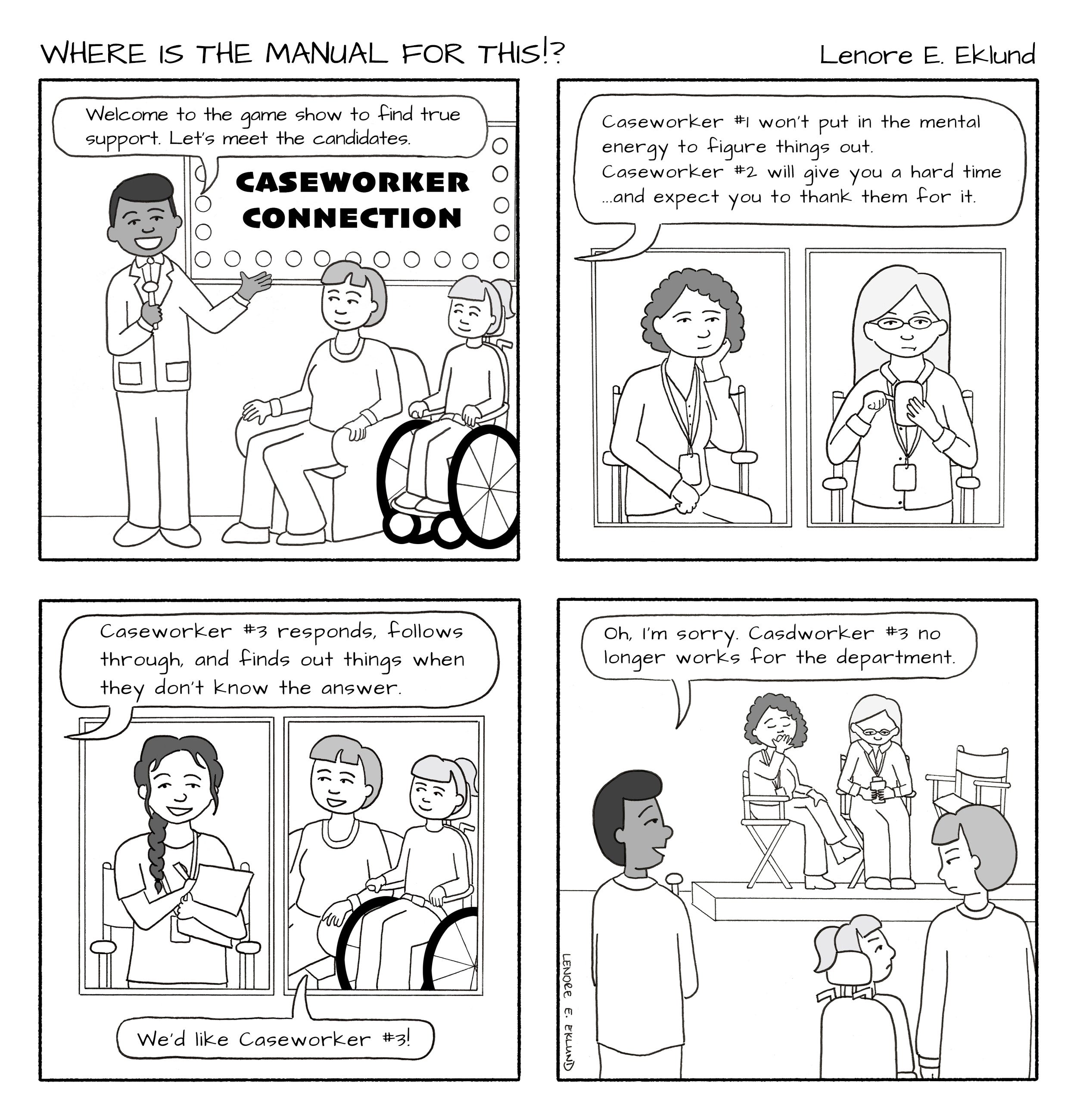
On the second Sunday of every month, we feature Where is the Manual for This?!, an editorial cartoon about the medical mom life from Lenore Eklund.
Editor’s note: I had a lovely vacation last week and came back to an inbox stuffed with news! The roundup is very full this week. The vacation happened to coincide with my usual behind-the-scenes quarterly report for paid subscribers, so that will come next week. Thanks for your patience!
Medical Motherhood’s news round up
Snippets of news and opinion from outlets around the world. Click the links for the full story.
• From The Oregonian: “Families say special education students have been an afterthought amid PPS school closure plans”
Twenty days ago, the families of students who receive special education services at Portland Public Schools sent a detailed report to the school district’s leaders seeking more information about how proposed building closures would impact hundreds of high needs children citywide.
Weeks later, they say they are still waiting for a complete reply.
[…]The 36-page report from the Special Education Parent Teacher Student Association starkly warns that it remains unclear whether and how potential school closures, program shifts and boundary adjustments would preserve equitable access to special education services and support for some of the system’s most vulnerable students.
[…]Superintendent Kimberlee Armstrong has acknowledged the omission of most of the special needs information in the scenarios originally circulated.
“When we pushed out the scenarios and we talked about the groups that are moving, we did not include our students with (Individualized Education Plans) and that was certainly a mistake,” Armstrong told a roomful of parents at Sabin Elementary School during a community meeting in late October. “We’re re-looking at where and how those students will move and what that may look like in the final recommendations.”[…]
• From Oregon Capital Chronicle: “Oregon, three other state AGs sue over Trump’s Medicaid work requirements”
Four Democratic state attorneys generals are suing the Trump administration over its plan to enact work requirements for people enrolled in Medicaid beginning in 2027.
In 2025, the massive federal tax and spending law championed by President Donald Trump and congressional Republicans put forth new rules requiring that Medicaid enrollees between ages 19 and 64 prove through monthly paperwork that they are employed, attending school or volunteering at least 80 hours a month.
[…]The Democratic attorneys general of Oregon, Minnesota, New Mexico and Washington filed a lawsuit Thursday afternoon in the U.S. District Court in Oregon, arguing that Congress and the Trump administration exceeded their constitutional authority by requiring states to implement these changes.[…]
• From The 19th: “Moms feared what the midterms would mean for their disabled daughters. Then came some hope.”
[…]Across the nation, Democrats triumphed at the polls, crucially winning majorities in both chambers of Congress. House Minority Leader Hakeem Jeffries, a front-runner to become speaker in January, said rolling back major cuts to healthcare social safety net programs would be a top priority. For [medical mom Yasmina] Halim and many family caregivers and disabled people, these Democratic gains and the promise of a legislative agenda that prioritizes trying to undo these cuts are a source of relief.
[…]“Until you’re in the thick of it, you really truly don’t realize how much politics is affecting your everyday life,” said Halim, who described the midterm results as giving “us a little hope.”
Halim, who describes herself as “purple,” rather than a dyed-in-the-wool Democrat, said her vote is often determined by policies, and specifically disability policy, which became a necessity after her daughter became ill.[…]
• From The Texas Tribune: “Parents of students with disabilities fear losing Texas’ “life-changing” school vouchers”
[…]More than 18,800 Texas students with disabilities are using school vouchers this year, according to the comptroller’s office, which manages the program. In total, at least 60% of all students participating are low-income, and about 17% have disabilities. All eligible Texas children could apply, regardless of disability or income status, but applicants with a qualifying disability and family incomes below 500% of the federal poverty level were given the highest priority.
[…]Some families described sending their children to public schools that failed to follow federal special education laws that require accommodations, causing them to lose trust. Others told the Tribune that their children’s severe disabilities made it difficult for them to learn at traditional campuses despite the best efforts of teachers and staff.[…]
• From Chalkbeat: “NYC sends 30% of students with emotional disabilities to segregated schools. Is this program a way out?”
[…]In the Path program, the goal is to help kids learn to manage challenging behaviors while keeping them integrated with general education classmates. Outcomes are promising, educational officials say, but the program is resource-intensive and remains very small. This year, the program costs about $14 million to operate 35 Path classrooms in prekindergarten through eighth grade.
[…]Federal law requires districts to keep students with disabilities in general education settings whenever possible, but New York City sends nearly 30% of its 8,000 kids classified as having emotional disabilities to separate, special-education schools run by the city’s District 75, according to an analysis of 2024-25 data published Thursday by the New York City Independent Budget Office at Chalkbeat’s request.[…]
• From Disability Scoop: “Caution Urged As Families Turn To AI For Help With Special Ed Disputes”
[…The Center for Appropriate Dispute Resolution in Special Education] noted reports about AI providing inaccurate information about how and where to file complaints and what types of issues can be resolved via dispute resolution options under IDEA.
The concerns led CADRE to develop technical assistance for families on how to properly use AI in special education disputes. The documents emphasize that while AI can be useful as a tool to help prepare for meetings or understand terminology, it does make mistakes, carries privacy risks and chatbots can encourage steps that escalate conflict.[…]
• From The Times (United Kingdom): “NHS wheelchair delays leaving patients injured or trapped at home”
Six-year-old Elliot Cruz Gardiyanoglu cannot walk, sit up, or control his own head without support. His cerebral palsy means he needs a specialist wheelchair to support his body so he can leave the house and go to school.
But because of [National Health System, the U.K.’s public health agency] delays, he was forced to wait more than three years for the vital equipment when he was diagnosed with the neurological condition aged 12 months.[…]
• From SBS News (South Korea): ““My Child Has a Developmental Delay”: Will the Endless Cycle of Jumping from Facility to Facility Ever Change?”
[…]According to a 2023 study by the Health Insurance Research Institute of the National Health Insurance Service, South Korea’s screening rate is very high. The study found that the “non-examination rate”—the proportion of children who did not undergo a single infant health screening—was only around 1.3%.
[…]Most parents who wait in line in sweltering heat or biting cold to get a screening ticket at a renowned pediatric clinic harbor serious worries about their child’s growth and development. While the 1.3% non-examination rate, praised as a ‘universal and outstanding screening system,’ is partly thanks to an accessible infrastructure that allows checkups anywhere, I believe more than half of that achievement was made possible by the desperate efforts and devotion of parents.[…]
• From Columbia Missourian: “A lifetime commitment: What caring for a disabled child means for one family”
[…]For the O’Briens, who also have three other children, caring for Bash is a lifetime commitment that involves managing his daily medical routines, navigating insurance claims and making sure he has the support he needs.
They are among 63 million Americans providing care for loved ones who cannot fully care for themselves, according to a survey conducted in 2025 by AARP and the National Alliance for Caregiving.
That means roughly 1 in 4 American adults are caregivers, with 59 million caring for adults and 4 million for children under 18 with an illness or disability.
Caregivers have become a largely invisible workforce where families, not institutions, accept the responsibility for an extraordinary amount of daily support.[…]
• From The New Daily (Australia): “Documentary gives rare glimpse into Colin Farrell’s challenges and hopes for disabled son”
Actor Colin Farrell has offered a rare and touching glimpse into his private family life, and the challenges faced by his eldest son James, in a new documentary.
The Slightest Touch explores friendship, disability and the challenges of running a marathon, as well as Farrell’s experiences as a father to a young man with debilitating Angelman syndrome.
• From Disability Scoop: “Movie About Disability Rights Activist Hits Theaters”
A major motion picture about one of the most pivotal times in the disability rights movement is headed to theaters and ticket prices at some locations are being slashed to honor the film’s focus on Section 504 of the Rehabilitation Act.
“Being Heumann” [opened in select theaters Nov. 6 and is now streaming on AppleTV…."]
• From KVAL: “Children with autism and related disabilities use ballet to build confidence”
On Wednesday, children with autism and other related disabilities joined professional ballet instructors to build a performance - and in the process, built confidence in themselves.
“Playing with movement is so joyful. It’s so joyful. It’s so freeing,” said Miranda Atkinson, Executive Director of #Instaballet.
Students at the Bridgeway House, a non-profit organization that supports children with autism and related disabilities, took a break from class to have some fun with ballet.[…]
Medical Motherhood brings you independent, ad-free news and information for raising disabled and neurodivergent children.
Free subscribers help this work reach more families. Paid subscribers make it sustainable. Get the newsletter in your inbox, give a gift subscription or become a paid supporter to help keep this resource available to everyone.
Not ready for a subscription but like what you read here? You can also buy me a coffee.
Follow Medical Motherhood on Facebook, Bluesky, X, TikTok, Instagram or Pinterest. Visit the Medical Motherhood merchandise store.