


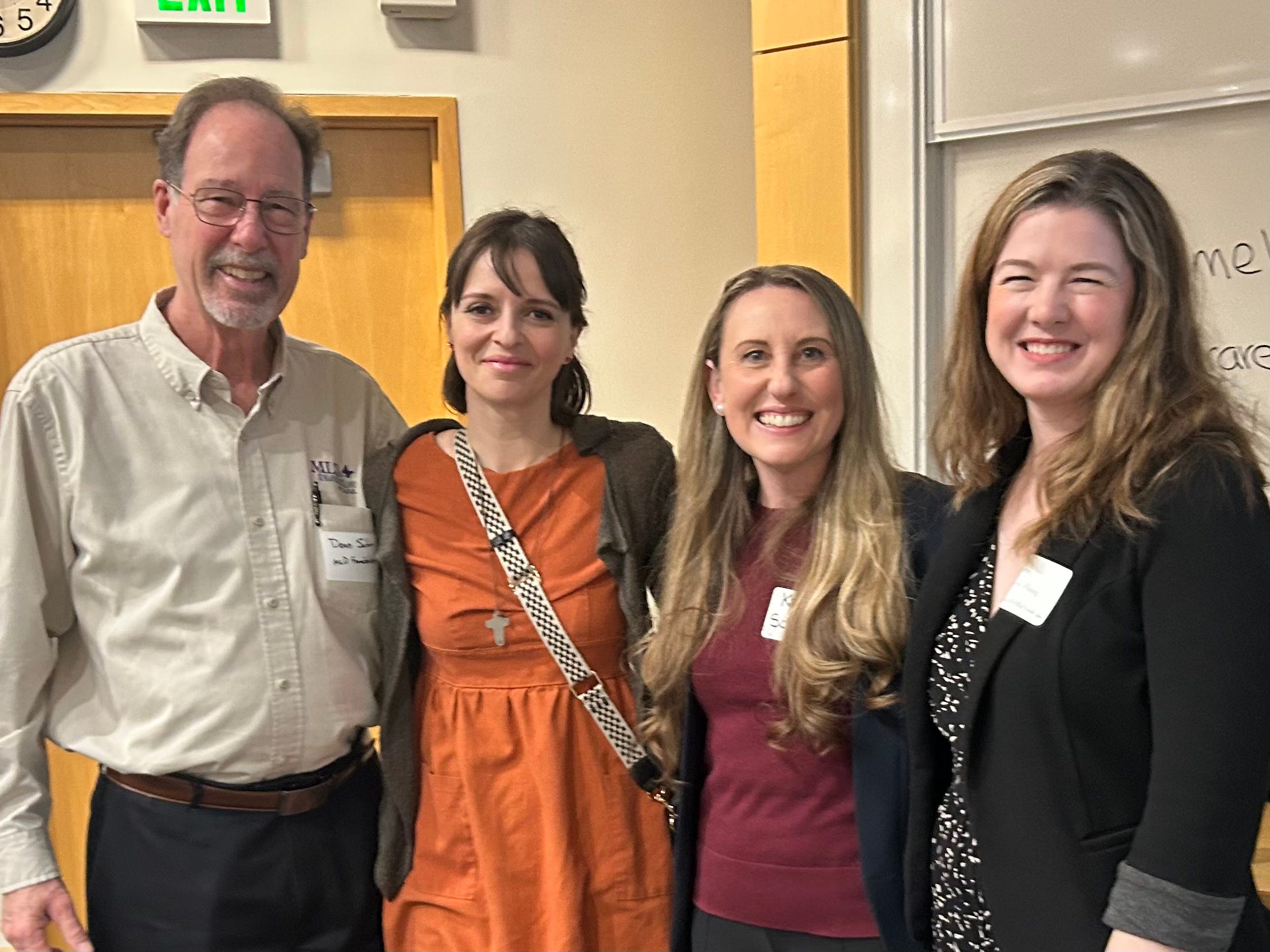
Greetings from Seattle!
I joined the fine folks above to speak at the Rare Disease Fair on Friday about employing family caregivers.
Please check out our sign-on letter asking the Trump administration and Congress to change policies and laws to make family caregivers employable by default — instead of through a complicated and wasteful waiver process. This simple change would only require deleting 10 words from federal law and allow disabled children and adults full access to the home care hours they have long been promised.

Story time.
During this trip to Seattle, we visited family and then took the long way back to our hotel via ferry. As I’m sure many of you can relate, my son (pictured above) had a meltdown at the exact least convenient time — right as we were paying the toll and getting on the ferry. The meltdown set off his twin, so my husband took him out and they walked on.
It was one of those times when we as medical mamas just keep our heads down and keep going forward, one step at a time. I gave him attention when I could, and got through the process to get us on the boat in a way that we could get him calmed down and out of the van near an elevator.
We got up to the passenger deck and headed to get popcorn — his favorite. The snack shack was a mass of bodies. We snuck through as best we could with the power chair and grabbed a bag. Then, I turned around to try to make sense of where the end of the line might be.
A guy in Seattle Mariner’s gear standing in line directly in front of us spoke up: “So, what I want you do to is to go around these folks and head to the front of the line and just pay there.” He spoke like a staff member. But I took another look at the baseball gear and hesitated. He doubled down: “Yeah, just tell ‘em me and this guy” — he jerked his thumb at the guy behind him, who laughed but then agreed immediately — “said it’s OK.”
So I laughed and said I would try it. We got to the front of the line and told the cashier the crowd wouldn’t let us queue up and the next person in line took one look at the power chair and said: “Oh, yeah. Totally.” We paid in a few seconds and a stressful ordeal was suddenly over.
It’s moments like these. Such small gestures, such minor inconveniences to them, but it is such a huge thing for us. That guy couldn’t have known what we had just been through, the way we needed a break. It just took one guy speaking up and everyone just reorganized to be kind and helpful.
Moments like those are why I rail against our disability systems so much. Because I see the good in people. I see how quick and easy it could be to do the right thing.
When we relate to each other at human speeds, at a human level, the answers are obvious.
Medical Motherhood’s news round up
Snippets of news and opinion from outlets around the world. Click the links for the full story.
Editor’s note: For those who missed the last issue, I asked readers if they preferred shorter snippets of more stories (if available) or my usual curated longer snippets of three to four stories. The response was pretty overwhelmingly in favor of shorter snippets of more stories. So, I’ll try that for a while.
• From Idaho Capital Sun via KMVT: “Idaho families can’t find caregivers for kids with disabilities. Lawmakers won’t consider a fix”
An Idaho Republican legislative leader signaled he won’t consider a bill to reinstate a program that paid family members to be caregivers for loved ones with disabilities – because it would cost money during a tight budget year.
[…]Rep. John Vander Woude, a Nampa Republican who chairs the House Health and Welfare Committee, which typically handles health care legislation, said the bill to reinstate the disability caregiver program didn’t have a chance this year because it could’ve cost $30 million.
[…]“These families have documented their extensive efforts to try to get (caregiver) agencies to come. Nobody will come,” [House Minority Leader Ilana] Rubel said. “They can’t leave the home. They are facing financial ruin. And it’s appalling to me that we’re doing nothing to help them.”[…]
• From AARP: “Family Caregivers Account for $1 Trillion in Essential Care”
[…]If family caregiving were counted as a formal work sector, it would rank among the largest and most valuable labor forces in the domestic economy. Yet many caregivers go unpaid and often have to leave full-time jobs to care for aging relatives or loved ones.
[…]Since the last “Valuing the Invaluable” report, which was released in 2023, caregiving demands have intensified. Family caregivers now average 27 hours of care per week, and 57 percent are in high-intensity roles, an indication that more are taking on complex medical tasks once handled by direct care and health care professionals.[…]
• From Flatwater Free Press: “Nebraska seeks to end retroactive Medicaid coverage. Hospital leaders say it will have a ‘disastrous’ impact.”
From her post in the neonatal intensive care unit at Children’s Nebraska, Dr. Ann Anderson-Berry sees some of Nebraska’s sickest and smallest patients.
It’s a devastating and unexpected end to a pregnancy, where the baby’s survival is often in question. For parents who rely on Medicaid, the government insurance program for low-income and disabled Americans, filling out the pages of paperwork to get their newborn covered is rarely top of mind.
[…]Those families — and other Medicaid-eligible patients seeking emergency care — have long had a grace period to apply, because by law, Medicaid would go back and retroactively pay for three months of care before the application.
[…]Nebraska’s Department of Health and Human Services is now seeking to end that retroactive coverage altogether.
• From Portland Press Herald: “Maine’s early childhood intervention system was broken. Schools are taking over.”
Fifty school districts have already assumed control of preschool and pre-K special education from the state and many more will follow suit in the fall. Although challenges persist, district leaders say the shift has benefited students.[…]
• From Frontiers: “Quality of life and emotional distress among primary caregivers of children with intellectual disabilities: a comparative study in China”
[…]A total of 217 primary caregivers of children diagnosed with ID were recruited from Jinzhou Kangning Hospital between January and December 2023, and 141 caregivers of children without ID from the same region were recruited online.
[…]In the context of family caregiving in China, caregivers of children with ID experience poorer QOL and greater emotional distress than caregivers of children without ID. These findings support the need for accessible psychosocial support and family-centered services, and for longitudinal research to clarify temporal pathways.[…]
Medical Motherhood brings you quality news and information each Sunday for raising disabled and neurodivergent children. Get it delivered to your inbox each week or give a gift subscription. Subscriptions are free, with optional tiers of support. Our paid subscribers make this work possible! Not ready to subscribe but like what you read here? Buy me a coffee.
Follow Medical Motherhood on Facebook, Bluesky, X, TikTok, Instagram or Pinterest. Visit the Medical Motherhood merchandise store.