


I’m getting a little mouthy in my old age.
As I’ve explained here before, Oregon could balance the budget in some pretty terrifying ways for the approximately 2,400 families of disabled children who would be cut off from Medicaid. This would be if they cut this state’s option called “parental income disregard,” which allows disabled children to qualify for Medicaid based on their own income (usually $0) rather than their parents’ income. Similar options are called Katie Beckett waivers or simply “waivers” in other states — because they “waive” the traditional income rules for Medicaid, America’s health insurance program for the poor.
So, this week, at a hearing of the state’s budget committee, I had planned a rather reasoned and staid speech, which you can read here. But after an hour and a half of listening to money requests, I kinda snapped. I needed legislators to understand the sorts of issues medical parents deal with regularly versus the important-but-not-exactly-death-defying traditionally funded government services.
You can watch a video of my testimony on my TikTok page or read the text below:
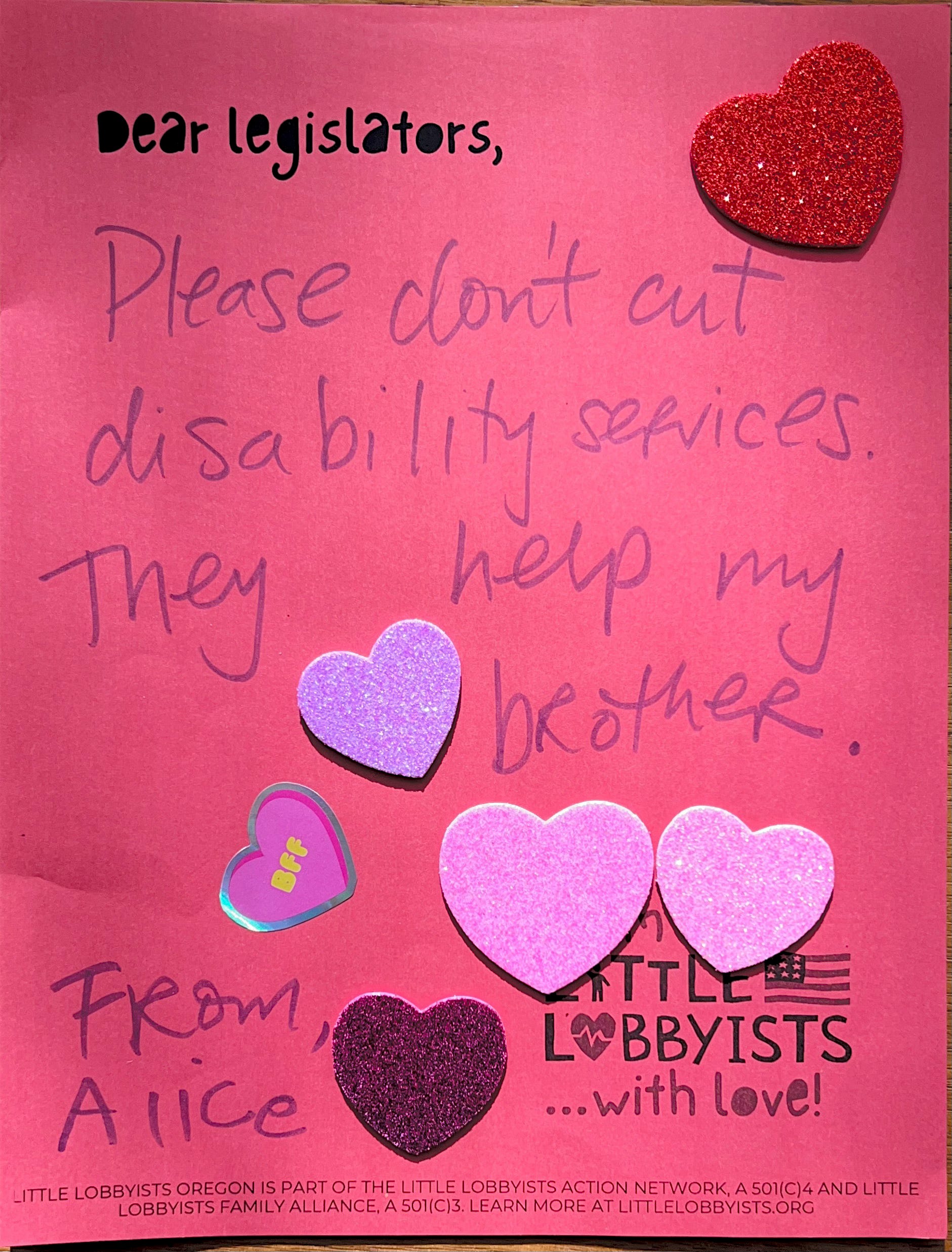
Hi, thank you. I have submitted written testimony, including many adorable valentines from kids imploring you not to cut disability services. But tonight I’m going to toss that and just speak from the heart.
I’ve heard a lot of people tonight use the words “vital” and “critical” and I have to wonder if any of them have had to watch their child struggle to breathe. Or spent hours every day trying to get them to eat enough. Or stayed up all night — night after night! — to manage a sensory meltdown, or seizure condition.
I was shocked to see children’s disability services on the cuts list from DHS [the Oregon Department of Human Services]. These should not even be on the list, let alone towards the top.
If we aren’t funding the services that let children survive, what are we even doing?
Disabled kids can’t just work harder or raise funds another way.
If their services are cut, we will all learn the meaning of the words “vital” and “critical.”
H.R. 1 did not change the federal match rate. While you have tough decisions to make to balance the budget, please listen to your youngest constituents and protect children’s services.
Happily, my testimony was joined by many others who also advocated for keeping parental income disregard, as well as autism level 1 eligibility and home and vehicle modifications — the other potential cuts to children’s services on Oregon’s list.
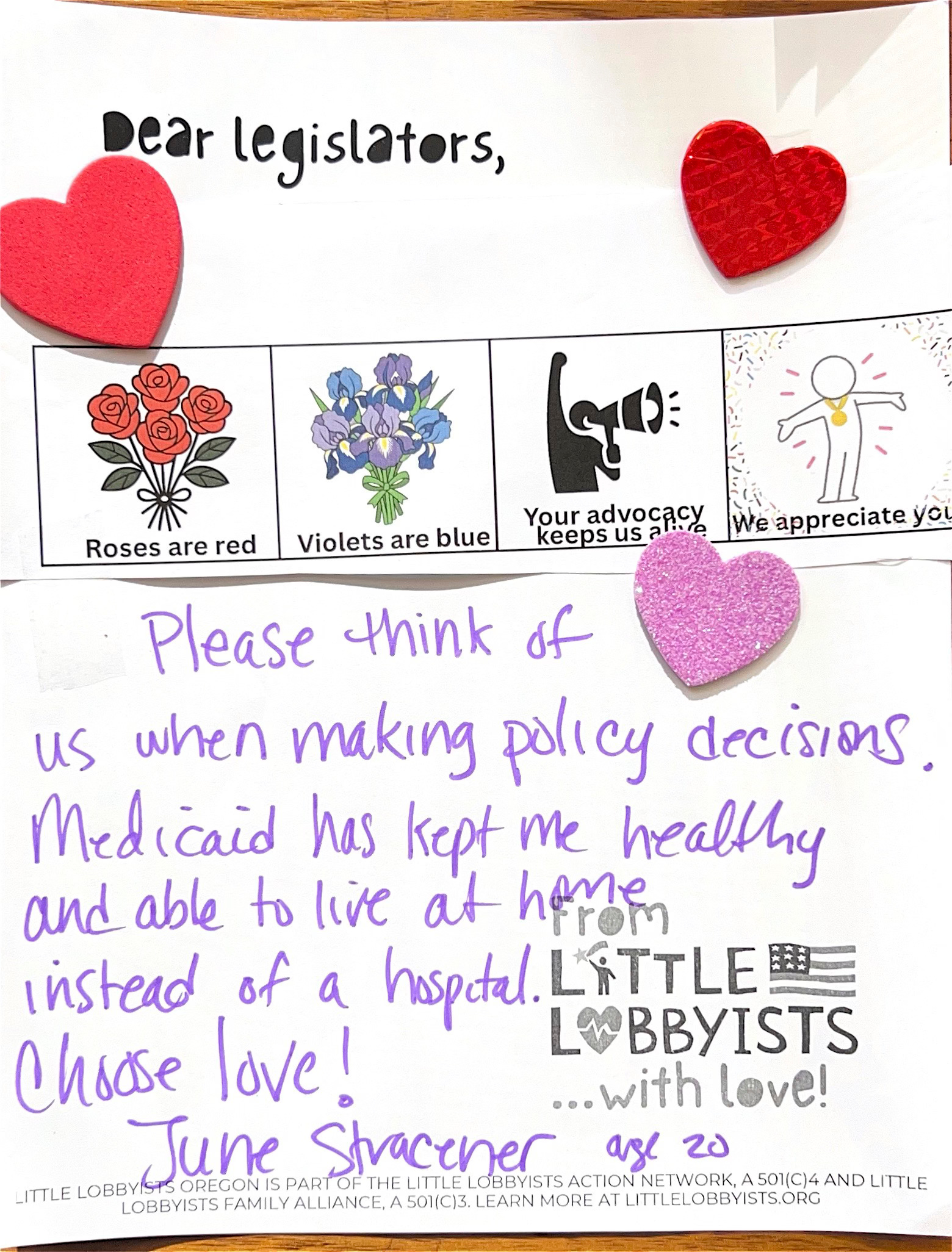
You can read more of their stories in this Capitol Chronicle article. The valentines I referenced are also visible at this link (scroll down) and were made at the kickoff party for the Oregon chapter of Little Lobbyists, which also got some press coverage this week. The valentines were a really cute and kid-friendly way to advocate for services.
Despite a much rosier tax revenue picture than when the legislature asked agencies to come up with budget cut options — from a $373M deficit in August, to a $63M deficit in November to a nearly $100M surplus last Wednesday — it is still unclear if children’s disability services are safe in the state.
Oregon’s short session ends March 8.
How’s it going in your states? How are your legislatures approaching the roll out of H.R. 1, otherwise known as the One Big Beautiful Bill Act?
Medical Motherhood’s news round up
Snippets of news and opinion from outlets around the world. Click the links for the full story.
• From KMTV: “Idaho families are bracing for possible Medicaid cuts”
Proposed cuts to Idaho’s Medicaid budget could eliminate critical services for families with disabled children, leaving Magic Valley parents worried about their children’s futures.
Megan Turner, parent of a disabled child, said the potential loss of services feels devastating for her family.
“It feels as if a chance for my child to have a normal life is being taken away from him,” Turner said. “If he’s not able to have these services that he needs and the program gets shut down completely it will be devastating for my family.”
[…]These services are caught up in a Medicaid budget debate that could mean cuts or changes. Proposed cuts to services that the legislature could take action on include a $176 million reduction to home and community-based care.
[…]“If this program is cut then they aren’t recognizing what an impact this will have on families and communities,” [home and community-based services provider Heather] Barnes said. “Hospitals will be overfull of children with behavioral difficulties that they don’t know what to do with. There’s been people mentioning putting children in residential places. They don’t exist in Idaho. There is no place for them to go.”[…]
• From Australia Broadcast Company (ABC): “Mother of autistic children shares experience in wake of suspected double murder-suicide”
A mother of two children with disabilities living in regional [Western Australia] wants other families to know there is “some light at the end of the tunnel”.
[If you or someone you know is having thoughts of suicide, call 9-8-8 for the U.S. national hotline.]
Jo Russell has shared her story of navigating bureaucracy while caring for children with complex needs — and the desperate moment she considered taking her own life.
It comes after last Friday’s suspected double murder-suicide, where teenagers Leon and Otis Clune, who lived with disabilities, were found dead in their Mosman Park home along with their parents, Jarrod Clune, 50, and Maiwenna Goasdoue, 49.
“It’s been a very difficult week … it hit a nerve with me,” Ms Russell said.
“I’ve walked in their shoes and I was so close to perhaps taking that course of action [suicide], but I didn’t.”
Ms Russell stressed her children were a “gift”, rather than a “burden”.
“I was in that dark space five or six years ago, and I want to share my story, because it’s the isolation when you have very complex children to look after, when you have to fight and advocate every day and find the strength to carry on,” she said.
[…]Ms Russell urged parents to share their story to remove the “awful isolation” she felt during times of adversity.
She said the reforms to the National Disability Insurance Scheme (NDIS) had placed additional pressure on parents and carers in the disability sector.
“It’s a multi-system failure,” she said.
“The systems designed to support us and assist us are complex, difficult to navigate, and organisations who provide support find it difficult to gain skilled staff.” […]
• From Disability Scoop: “Trump Wanted To Cut Disability Programs. Congress Just Said No”
After months of uncertainty, federal lawmakers approved a spending package that rejects Trump administration efforts to alter the Individuals with Disabilities Education Act and do away with some disability programs.
President Donald Trump signed a bill this week to fund much of the federal government through September. The deal brings to a close a tumultuous period for disability programs punctuated by two government shutdowns.
[…]In his budget request last year, the president called for altering IDEA to allow federal funding for certain programs to be consolidated in order to give states more control over spending, but Congress chose not to act on that plan. Advocates said that if such a change had gone through, it would have affected Parent Training and Information Centers, technical assistance centers, training for new special educators and general educators, assistive technology and accessibility supports and more.
[…]Trump had also urged Congress to eliminate funding for University Centers for Excellence in Developmental Disabilities, or UCEDDs, and some programs serving people with disabilities at protection and advocacy agencies, but lawmakers chose to maintain them.
[…]Alison Barkoff, a health law and policy professor at George Washington University who previously led the Administration for Community Living [said:] “Advocates will need to ensure that agencies quickly disburse critically needed appropriated funding and that the administration heeds to the directives of Congress regarding agency reorganizations.”
Medical Motherhood brings you quality news and information each Sunday for raising disabled and neurodivergent children. Get it delivered to your inbox each week or give a gift subscription. Subscriptions are free, with optional tiers of support. Our paid subscribers make this work possible! Not ready to subscribe but like what you read here? Buy me a coffee.
Follow Medical Motherhood on Facebook, Bluesky, X, TikTok, Instagram or Pinterest. Visit the Medical Motherhood merchandise store.
Get mouthy. Be your glorious smart savvy passionate big-hearted self. Your words and testimony matter. Thank you, Shasta.
This newsletter did shine a flame if hope in some dark spaces. The struggle and advocacy continue.