
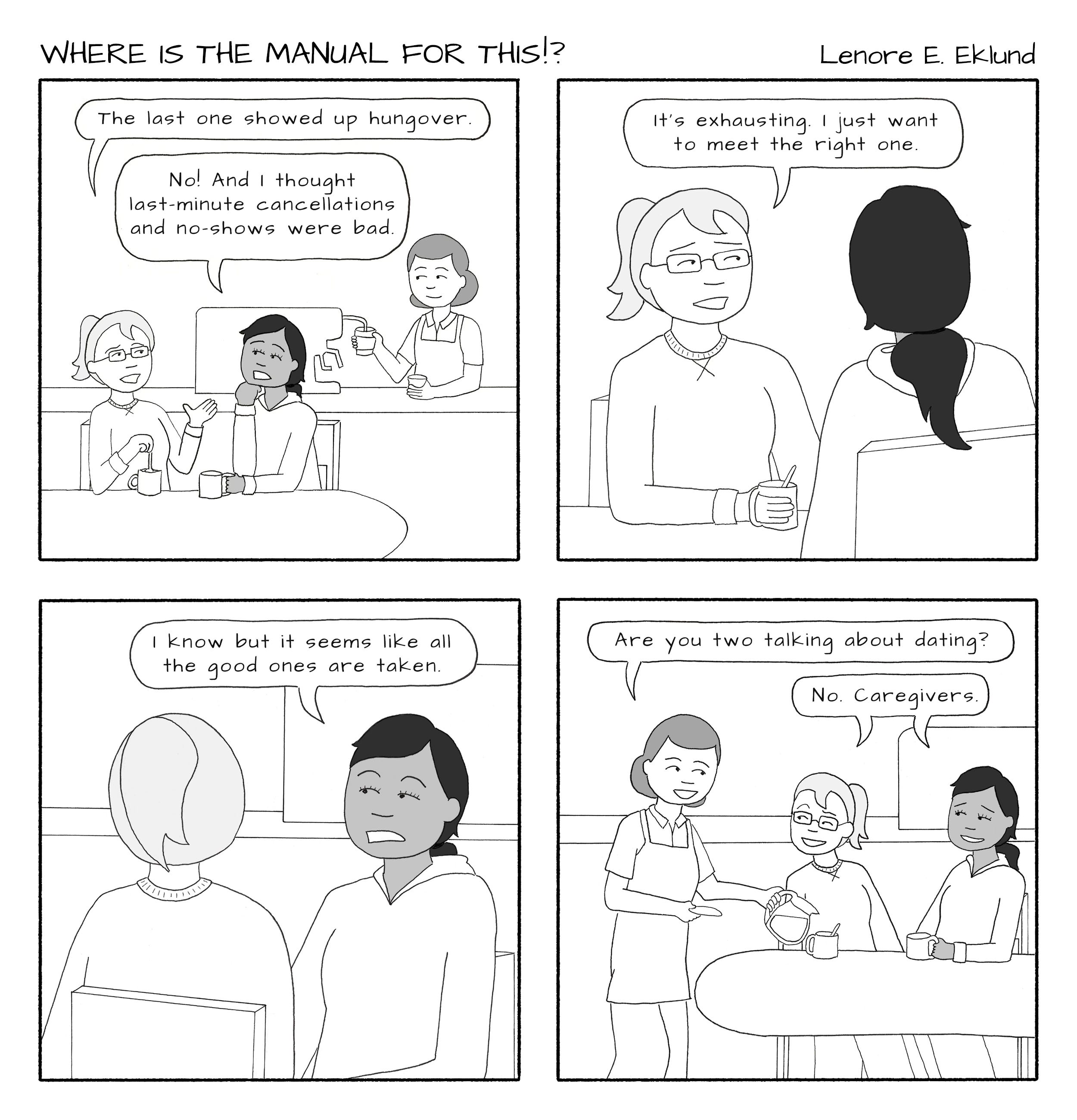
Matchmaker, Matchmaker, Send Me a Caregiver...
Plus: Kansas mulls quarterly Medicaid redeterminations; Canadian researchers warn of cliff for care of complex disabilities in adulthood; Washington considers slashing early intervention
Finding the right caregiver really does feel like dating! Love and care go hand in hand, even when care is a “job.” Personality fits can go a long way towards finding the right match. Even though we aren’t speaking of romantic love when talking about caregivers (no, thank you!), love is very much an ingredient to the right care mix. The ancient greeks identified six types of love, five of which are not romantic. This Valentine’s Day, take time to reflect on the many types of love you have for those on your care team and the love they have for you and your child.
Medical Motherhood’s news round up
Snippets of news and opinion from outlets around the world. Click the links for the full story.
• From the Kansas Reflector: “Forty individuals, organizations object to Kansas Senate bill adding barriers to food and health aid”
On Tuesday, the [Kansas] Senate Committee on Government Efficiency, or COGE, heard from the lone proponent of [a bill that would add numerous barriers to Medicaid and SNAP benefits] — a conservative Florida organization that has sought for more than a decade to slash participation in Kansas public assistance programs.
[…Little Lobbyists State Outreach Manager Melissa] Sabin said requiring determinations of eligibility to be repeated monthly or quarterly would lead to additional paperwork errors, missed notices or administrative delays rather than documentation of alleged fraud or abuse.
She said a proposal for recipients of Medicaid to have eligibility reassessed every three months, rather than at 12-month intervals, could violate federal regulations. In terms of her son, she said the bill would compel the state to reconsider four times each year whether Logan, born with a genetic disorder characterized by intellectual disabilities, was eligible despite lack of change in his medical diagnosis.
“His condition does not fluctuate with paperwork cycles,” his mother said. “His need for skilled care does not disappear because the form is refiled or a verification is resubmitted.”
[…]Under the Senate bill, the Kansas Department of Health and Environment and the Kansas Department for Children and Families would be required to establish data-matching systems to automatically share personal information on Kansans with other state agencies. KDHE would have to submit data to the federal government on a monthly basis to determine if Kansans were enrolled in Medicaid in other states.
[…]The fiscal note attached to the Senate’s bill indicated state agencies would need to hire about 300 new employees to handle the revised eligibility processes. The Kansas Department of Administration estimated the cost of complying with the law would be $17 million to $18 million annually.[…]
• From Holland Bloorview Bloom Blog: “When kids with complex needs become adults, care falls apart”
Young adults with childhood conditions like cerebral palsy have longer, more costly hospital stays and are more likely to be readmitted within 30 days, according to a new study in JAMA Network Open led by researchers at The Hospital for Sick Children (SickKids) in Toronto [Canada].
“As the number of children with complex chronic conditions surviving to adulthood continues to increase, this population will continue to grow,” says lead author Dr. Sarah Malecki, a general internist and PhD student in the Cohen Lab at SickKids.
But the adult healthcare system “was not built for the type of coordinated care they need,” she says.
Researchers reviewed data related to almost 20,000 hospital admissions by adults aged 18 to 39 who were discharged from 29 acute-care hospitals in Ontario in 2018.
Young adults with complex congenital conditions like cerebral palsy, sickle cell disease and cystic fibrosis represented 6.7 per cent of those admissions, yet they used almost 11 per cent of all hospital bed days.
[…]“I have heard too many times from patients and families that the transition to adult services can feel like ‘falling off a cliff,'" says co-author Dr. Eyal Cohen, a pediatrician with SickKids’ complex-care team who heads the hospital’s Child Health Evaluative Sciences.
[…]The researchers say we need to invest in new models of care to address the unique needs of this adult population.[…]
• From Nonstop Local: “Washington considering bill to cut funding to child development programs”
[…]In the 2026 legislative session, a proposed bill, could change how [Washington’s Early Support for Infant and Toddlers (ESIT) Program] funding is allocated to programs like Joya, and after an amendment accepted Monday, could decrease funding to 2008 levels.
[…]Representative Joshua Penner explained[…:]“Traditionally, the funding, for the various programs is tied to the funding rate of K-12, and K-23 special education specifically,” Penner said. “the belief there is that for these individuals, this is part of their education development, because they need that kind of instruction to work up to a place where they can move into a school system later on.”
HB2688 proposed decoupling the rate, meaning that instead of being attached to K-12 Special Education, the funding would stand alone.
[…Early intervention services provider] Joya's director of strategic programs and initiatives Jessie Laughery says the current version of the bill could result in a $31 million statewide cut annually, translating to a $1 million loss for Joya each year.
[…]Laughery said that in just the last year, the number of children served by Joya has skyrocketed.
“We’ve served just over 700 putting us on pace to serve 1500 kids this next year. That’s a 60% growth from last year,” Laughery said.
A $1 million cut could limit the families served.
“We’re not able to say, go find these services elsewhere because they don’t exist,” Laughery said.
[…]Joya reports that 64% of kids leave the program at age 3 having met age-appropriate milestones and do not require further intervention.
“We certainly understand the tough position that the state legislature is in,” Laughery said. “But we also know that what costs us a dollar today might cost us $5 down the road in special education services.”[…]
Medical Motherhood brings you quality news and information each Sunday for raising disabled and neurodivergent children. Get it delivered to your inbox each week or give a gift subscription. Subscriptions are free, with optional tiers of support. Our paid subscribers make this work possible! Not ready to subscribe but like what you read here? Buy me a coffee.
Follow Medical Motherhood on Facebook, Bluesky, X, TikTok, Instagram or Pinterest. Visit the Medical Motherhood merchandise store.


