



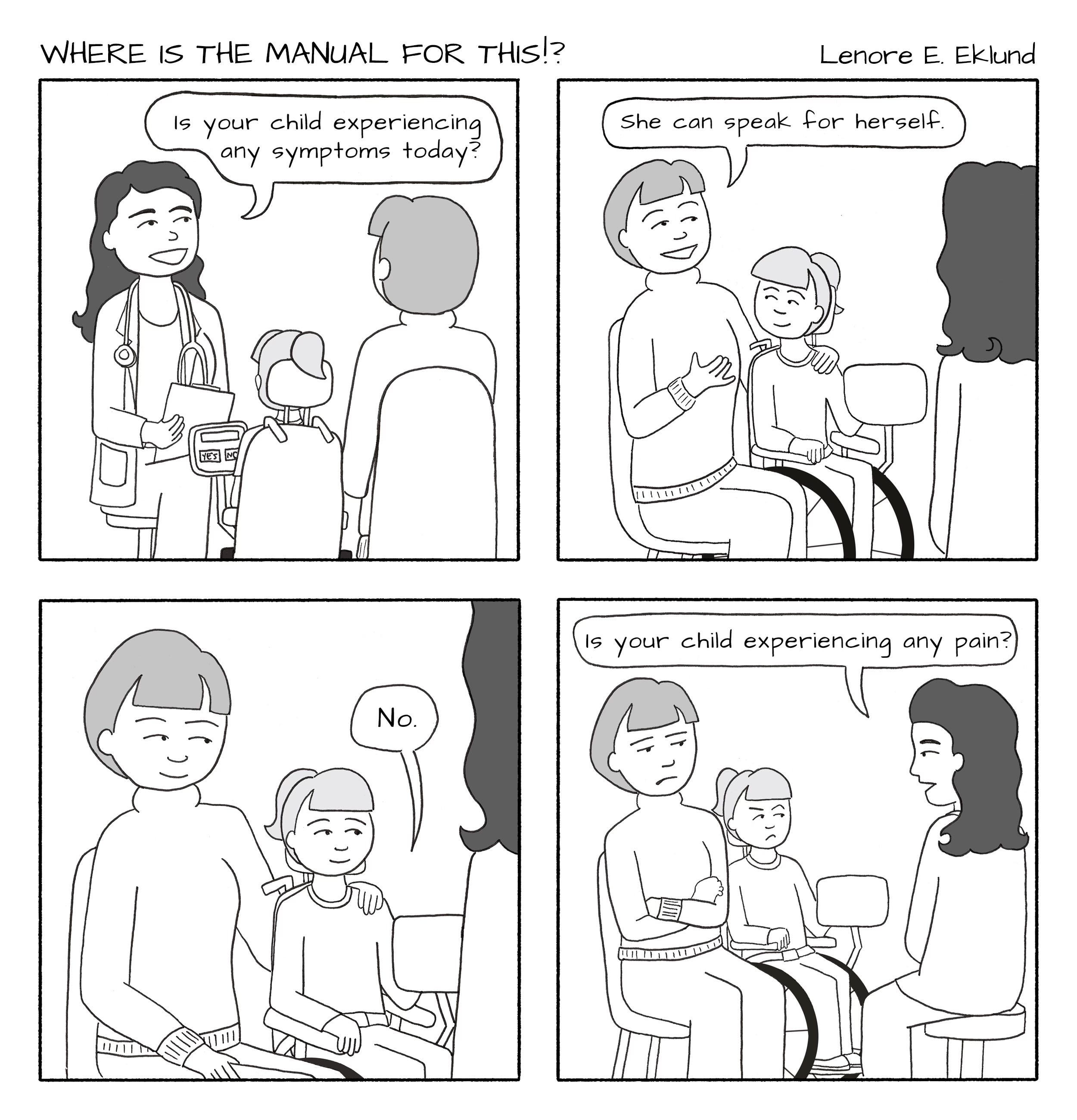
This month’s Where is the Manual for This?! comic takes on a familiar experience for many disabled people and their families: the provider who talks around the disabled person instead of to them. It can happen in doctor’s offices, therapy rooms, schools and service meetings — a question is directed to the parent or caregiver while the disabled person sits right there, fully able to understand and answer for themselves.
Providers should presume competence in all circumstances, but especially when clearly shown that the person can answer for themselves.
On the second Sunday of every month, we feature Where is the Manual for This?!, an editorial cartoon about the medical mom life from Lenore Eklund, who now has her own Substack!
Medical Motherhood’s news round up
Snippets of news and opinion from outlets around the world. Click the links for the full story.
• From Disability Scoop: “Medicaid Changes Will Push People With Disabilities Off Program, Advocates Warn”
[…]The Centers for Medicare and Medicaid Services issued an interim final rule this week spelling out standards for Medicaid work requirements, which most states must implement by the start of next year.
The so-called “community engagement” requirements stipulate that many Medicaid beneficiaries must prove that they are working, volunteering or going to school at least 80 hours per month in order to qualify for coverage. The new mandate was part of a sweeping law approved by Congress last summer that included nearly $1 trillion in Medicaid cuts.
[…]However, the rule is setting off alarm bells for disability advocates who warn that the parameters put forth by CMS for people with disabilities to claim an exemption are far more limited than the definition of disability under the Americans with Disabilities Act.
“Despite Congress’ promises that people with disabilities will be exempt from these requirements, not all people with disabilities are exempt. Disabled people will lose access to Medicaid,” said Maria Town, president and CEO of the American Association of People with Disabilities.[…]
• From Tennessee Lookout: “Tennessee to report disabled immigrant kids getting public healthcare to ICE, advocates say”
Scores of low-income immigrant children living with critical illnesses could soon lose access to life-sustaining medical care after Tennessee officials directed public health departments to verify their immigration status and report to the federal government, according to the Tennessee Justice Center.
The Tennessee Department of Health is targeting Children’s Special Services, a last-resort public health insurance program for kids with disabilities and life-threatening illnesses, such as cancer, spina bifida and terminal diseases. […]
• From Fox 45 News: “Maryland ‘fudged the numbers’ on disability budget cuts, lawmaker says”
When Maryland lawmakers slashed $126 million from the state’s disability budget earlier this year, they justified the move with a dire warning: the state’s waiver program for home and community-based care was at risk of federal termination unless the budget was reined in.
But advocates, and a state lawmaker who proposed a last-minute amendment to reverse the cuts, now argue that the state’s fiscal alarm was manufactured.
[…]Federal officials appear to be contradicting the state’s narrative. The Centers for Medicare and Medicaid Services (CMS) told Spotlight on Maryland it has never issued any notice indicating that Maryland’s waiver was at risk of termination due to cost-neutrality concerns.[…]
• From Dayton Daily News: “What happens when a child with disabilities gets taller, stronger, and the family needs support?”
[…]The struggles to get home health care for her son have left Rodriguez frustrated. She works with home health agencies to get aides to help since Miguel needs 24/7 care. He has also been diagnosed with cerebral palsy and developmental delays in addition to the epilepsy.
“I have been working on fundraising to get a wheelchair accessible van,” Rodriguez said. “I have almost dropped Miguel a few times because he’s heavy and it’s awkward to lift him in and out of the car. I can’t continue to do this because I’m afraid I will hurt him or myself.”[…]
• From Irish Times: “‘It’s relentless’: Mother caring for disabled twin children says respite ‘critical’ for carers”
A woman who is caring for both of her 12-year-old twins has said she would describe her life at times as “not living but just existing”.
[…Catherine] Rossiter shared her situation as Family Carers Ireland warned that family carers are being pushed deeper into financial hardship and social isolation.
The charity’s State of Caring 2026 report revealed 71 per cent are finding it difficult to make ends meet, while almost half experience severe loneliness.[…]
• From NPR via Georgia Public Radio: “Screens are leaving schools fast, though some students with disabilities rely on them”
[…]Much of the pivot away from screens in schools has come from parents who are concerned screen use is getting in the way of their children’s learning — an argument Heather Martin hears in her own community in Concord, 30 miles northeast of San Francisco. She shares some of those concerns, but says, “Never once in the conversation has there been a discussion, except for me bringing it up with the other parents, about kids with disabilities.”
Advocates worry those students are also being left out of the national conversation.
[…]"A completely screen-free environment feels like it's throwing the baby out with the bathwater," [mom Heather Martin] says. "It's not looking at 'screen free' versus 'accessibility free.' And for some kids, the screen is their accessibility tool."[…]
• From Newsbook Malta: “Federation slams decision to remove disabled children from mainstream education”
The Malta Federation of Organisations of Persons with Disability (MFOPD) has criticised a decision that will see some students with disabilities removed from their mainstream school environment from next week, warning that the move undermines their right to inclusive education and was taken without consultation with disability organisations.
[Malta is a small island nation in the Mediterranean Sea, near Italy.]
[…]The federation said that, without any consultation with disability NGOs or the Commission for the Rights of Persons with Disability (CRPD), educational authorities had decided that, from Monday 8 June, some students with disabilities would be required to participate in a three-week learning programme in a segregated setting.
[…]“They are entitled to attend school and benefit from their educational programmes until the end of June, just as their peers do,” the statement said.[…]
• From The Times (U.K.): “Children too easily diagnosed with ADHD and autism, GPs say”
Family doctors believe diagnoses for ADHD and autism are being given out “too easily” to children, including to those who may simply need behavioural help, a survey has found.
[…]The survey found that 57 per cent of GPs agreed that “financial entitlements linked to autism or ADHD diagnoses strongly influence parental requests for assessment”.
Claims for child disability living allowance (CDLA), which is not means-tested, doubled from 420,000 children in 2016 to almost 900,000 last year. The rise was driven almost entirely by children under the broad category of “behavioural disorder”, plus learning difficulties and ADHD.
[…]Charities have tried to debunk the idea that parents are seeking diagnosis for financial benefit by pointing out the long, stressful and arduous route to formal diagnosis and the hidden extra costs of raising a child with special needs, such as specialist therapies, legal fees while fighting for support and disruption to their work due to caring responsibilities.[…]
Medical Motherhood brings you independent, ad-free news and information each Sunday for raising disabled and neurodivergent children.
Free subscribers help this work reach more families. Paid subscribers make it sustainable. Get the newsletter in your inbox, give a gift subscription or become a paid supporter to help keep this resource available to everyone.
Not ready for a subscription but like what you read here? You can also buy me a coffee.
Follow Medical Motherhood on Facebook, Bluesky, X, TikTok, Instagram or Pinterest. Visit the Medical Motherhood merchandise store.