


Longtime readers will know that this is the time of year is when we usually do the Medical Motherhood Games — an Olympics spoof celebrating the outstanding and unnoticed feats that we medical mamas do all the time. But this year, I’d like to play a different game.
Reader Alicia Ibaraki came up with a Medical Mama bingo card which you can download here.
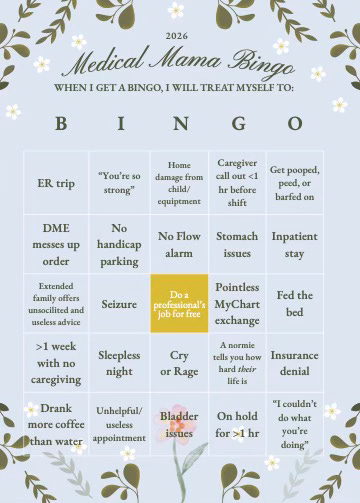
If you print off your own copy, I can speak from experience and say that crossing the spots off with a black marker is cathartic. And hey, I’m almost at a Bingo. I have to decide what my treat will be!
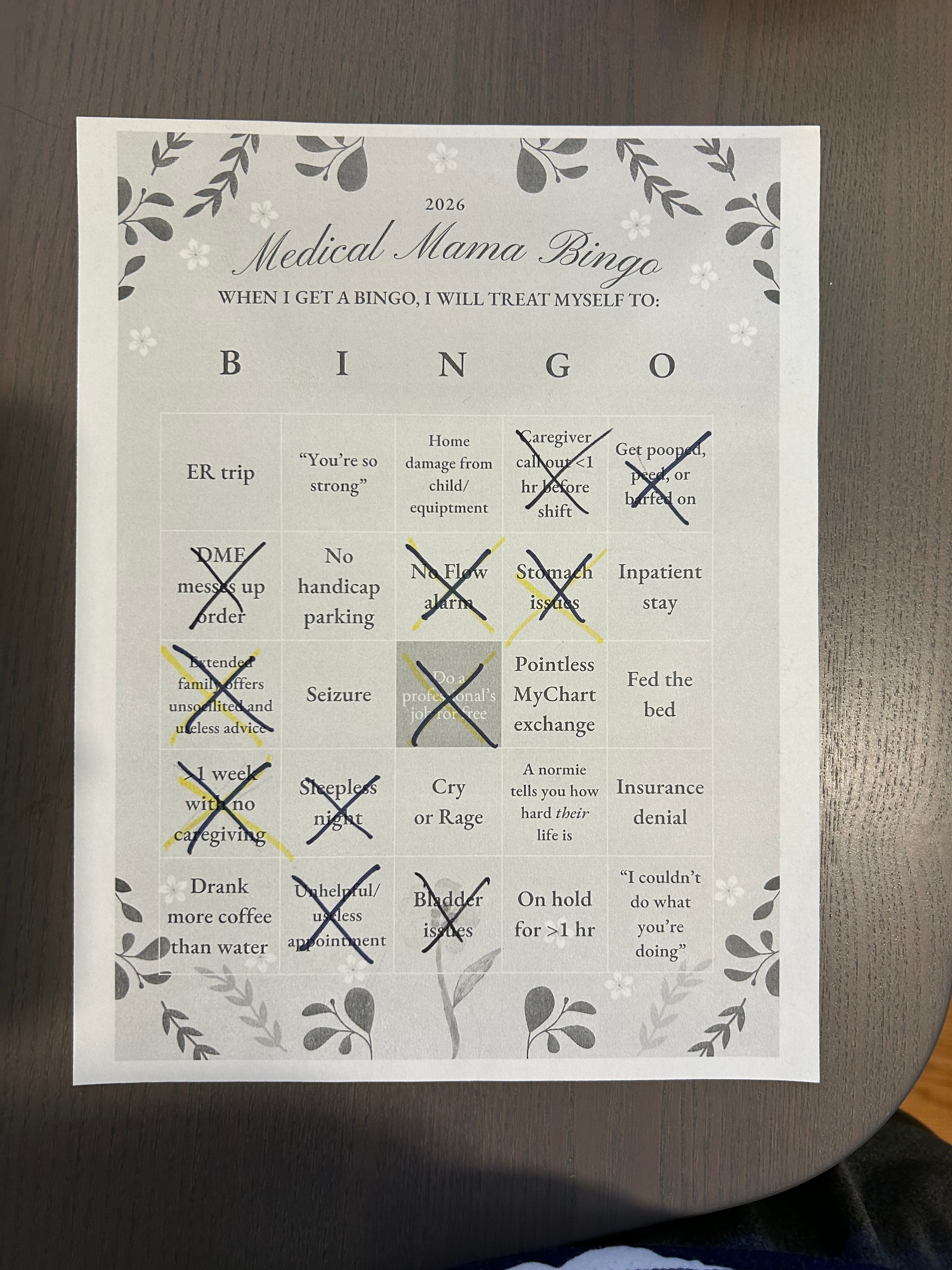
Yes, I printed it because I’m an elder millennial, but you can also just save it to your phone and cross off your bingo boxes digitally.
Anyone who gets a Bingo before Mother’s Day — Sunday, May 10 — please let me know! I’ll give away a free paid subscription (or an extra year on your current subscription) to the first person to get a bingo. Plus! Anyone who even participates in the bingo game, tell me and I’ll enter you in a drawing for a subscription. Winners and participants will be announced in our special Mother’s Day edition!
Medical Motherhood’s news round up
Snippets of news and opinion from outlets around the world. Click the links for the full story.
• From Miami Herald: “Florida failing its most vulnerable children; baby dies, appeals court says”
Florida’s “widespread” violation of severely disabled children’s civil rights has caused scores of youngsters to be raised in sterile institutions far from their families, a federal appeals court found, rebuking the state for failing Florida’s frailest children.
The 11th U.S. Circuit Court of Appeals found that Florida’s unwillingness to provide adequate in-home nursing care to the state’s most fragile children has caused at least 139 youngsters to be institutionalized in nursing homes generally reserved for elders, some of them there since they were babies. Another 1,800 children are at risk of being placed in nursing homes due to the state’s failure to provide care.[…]
• From The Center Square (Illinois): “Lawmaker calls for department reform supporting Illinois families with disabled children”
A Republican state representative in Illinois is continuing his push for simpler and less burdensome paths to care for disabled residents and their families.
A longtime disability advocate in the statehouse, Rep. Charlie Meier, R-Okawville, gathered with advocates and parents Tuesday to speak about his proposed legislation that would address their perceived failings of the state’s Department of Human Services.
House Bill 5129 would prevent families or guardians of children with developmental disabilities from having to give up custody of their child in order to access more state services.[…]
• From The 74: “Shaping Schools to Fit Students With Disabilities Leads to Academic Gains”
In traditional school settings, students with disabilities often bear the burden of advocating for accommodations and ways to fit into classrooms not made for them. But at three schools in New York, Minnesota and Wisconsin, these students are at the center of operations — and it’s paying off with improved student outcomes.
New case study research of these schools, shared exclusively with The 74, was published Thursday by Education Reimagined, a national nonprofit that helps schools implement learner-centered education. It’s an approach where young people have ownership of their education, learn in their communities and show their knowledge through multiple ways, not just tests, according to the nonprofit.[…]
• From The Imprint: “Minnesota Foster Youth Call on State Lawmakers to Stop Seizing Their Federal Benefits”
On Wednesday, more than a dozen Minnesota foster youth and their supporters attended a hearing to implore legislators to set aside and protect their survivor and disability benefits — millions of dollars in federal funds currently fed into county coffers.
[…]State Sen. Melissa Wiklund’s bill would require counties to assess children’s eligibility for federal, state, or other cash benefits, and apply for the benefits for as long as the child is in foster care. The money would be deposited into a trust fund account and saved until they turn 18. Foster youth who need the money prior to that date could have their attorneys petition the family court for permission to access it.
Under the currently proposed legislation, the Department of Children, Youth and Families must identify foster youth whose benefits were taken between 1976 and 2026 and repay them money owed. The legislation would allocate $15 million in fiscal year 2027 for that purpose.[…]
• From BBC Scotland News: “Families fear for future of centre for severely disabled children
[…]BBC Scotland News has seen correspondence which shows NHS Lothian is considering closing one of two respite homes in Livingston and Edinburgh due to severe financial pressures.
[…]Lynsey and Mark Scott's nine-year-old daughter, Thea, has a rare genetic disorder that sees her spend up to eight days a month at Sunndach.
[…]Even with nursing staff on hand around the clock, NHS rules dictate that one parent must always be present at home, so life is hard for the couple.
[…]Thea's family moved home to be ten minutes' drive from nine-bedded Sunndach.
"Many of the families we look after at Chas are in poverty and many of them have given up their jobs to look after their children, they are full-time carers," Okasha said.[…]
• From Philadelphia Inquirer: “Disabled children are being kicked out of preschools at alarming rates, report finds”
One preschooler with autism and ADHD was excluded from a Philadelphia early childhood program two hours after her parents dropped her off for her first day because the school did not have adequate supports, according to a new report from the Education Law Center-PA.
Another was told he was “no longer a good fit” shortly after starting a program where directors had said they would have no trouble working with the boy, who has autism. He was 2.
At another school, a young boy with autism was not fed if certain staff were not present; the school suggested the child attend on a restricted schedule, and often did not allow him to use the electronic device the nonverbal boy needed to communicate his needs.
Pennsylvania’s youngest learners are expelled or excluded from preschools at alarming rates — often because of student disabilities — an illegal practice that challenges families and can cause children long-term harm, according to the report, which was released Tuesday.[…]
Medical Motherhood brings you quality news and information each Sunday for raising disabled and neurodivergent children. Get it delivered to your inbox each week or give a gift subscription. Subscriptions are free, with optional tiers of support. Our paid subscribers make this work possible! Not ready to subscribe but like what you read here? Buy me a coffee.
Follow Medical Motherhood on Facebook, Bluesky, X, TikTok, Instagram or Pinterest. Visit the Medical Motherhood merchandise store.