


For those interested in the paid family caregiver debate, it has been a blockbuster news week.
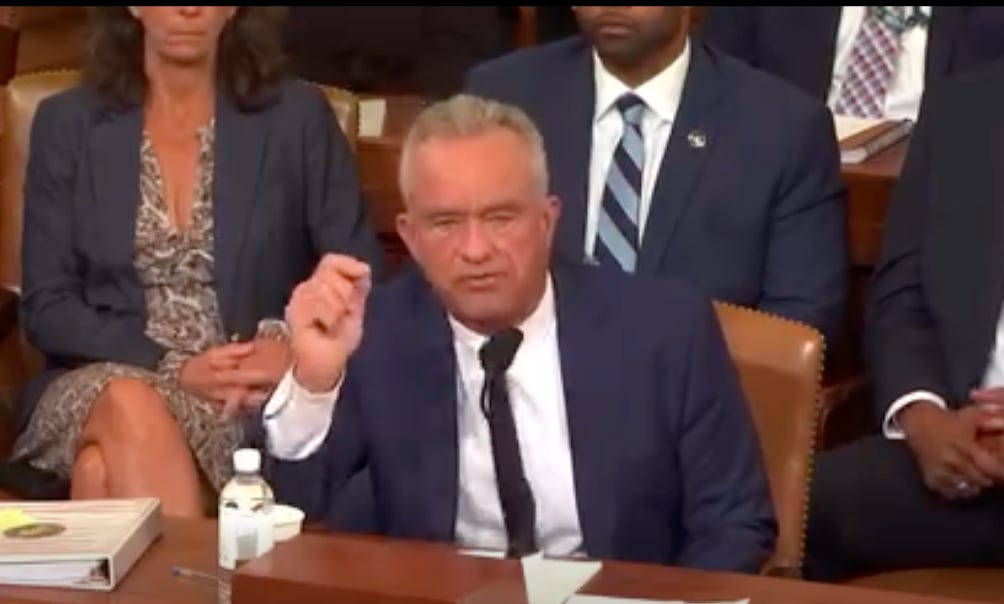
On April 16, Secretary Robert F. Kennedy, Jr. testified in front of the U.S. House Committee on Ways and Means in a budget hearing. (Watch the video here.) Kennedy criticized waiver services that allow family members to be paid to provide services “that they used to do as family members for free and this is rife with fraud because we at CMS to determine whether they actually performed that duty or not.”
Kennedy is the head of the U.S. Department of Health and Human Services, which manages the Centers for Medicare and Medicaid (CMS). As such, he should know that waivers were invented by the Reagan Administration as a much more humane (and affordable) way to provide Medicaid-funded care to disabled humans. These programs “waive” the rules for institutional care and allow for people to be cared for in their homes and communities. Home care waivers are also called Home and Community Based Services. Most of the people on waivers are not the elderly (though those do exist) but disabled adults and children with lifelong conditions.
Kennedy should also know that there are many checks and balances on these services. They are not easy to qualify for and there are numerous hoops to jump through once you do. These include electronic visit verification in which disabled people’s every movement is tracked through their caregiver. We do not expect able-bodied people to live under a surveillance state, yet we make disabled people do this and they are still criticized.
Finally, Kennedy seems to equate sudden increased use of the service with fraud. In fact, disabled families have been complaining for decades that the home care hours they have been promised are impossible to use and that there is a massive shortage of these workers. During the flexibilities allowed under the COVID-19 Public Health Emergency, we learned that family members are reliable care providers, so more states started allowing this permanently. The explanation for this is not simply fraud — it means suddenly disabled adults and children are finally getting the service they have been promised for decades.
Just over a month ago, I wrote that the Medicaid ‘fraud’ witch hunt had begun. They started with claiming that providers — agencies, organizations, etc. — were committing massive quantities of fraud. There are certainly some cases of that and we already have a massive apparatus to catch and prosecute those cases. But the rhetoric has already slipped to blaming grandchildren of the elderly for getting paid to “balance a checkbook” or “drive to the doctor’s office.”
Parents of disabled children who are, or want to be, paid care providers should start speaking up now because we are the next stop on the train.
If you want to speak about this issue directly to decision makers, here’s how.
In case you missed last week’s issue, we’re playing Bingo all this month. Download your copy here. Read more:
Medical Motherhood Bingo!

Longtime readers will know that this is the time of year is when we usually do the Medical Motherhood Games — an Olympics spoof celebrating the outstanding and unnoticed feats that we medical mamas do all the time. But this year, I’d like to play a different game.
Medical Motherhood’s news round up
Snippets of news and opinion from outlets around the world. Click the links for the full story.
• From NBC News: “RFK Jr. draws backlash for ripping Medicaid programs that pay people to care for relatives”
Health and Human Services Secretary Robert F. Kennedy Jr. sparked outrage among disability rights advocates with recent comments alleging widespread fraud in Medicaid programs that pay people to care for elderly or disabled family members — a system millions of Americans rely on to survive.
• From Washington State Standard: “Why families caring for children with disabilities are suing Washington state”
“I’m employee of the month, Colby would tell you, even though he can’t,” she said. “I show up every day. I never have a sick day, I’m always here.”
When it comes to support from the state, Thompson, like many parents providing care to disabled children, falls into a gap.
Washington compensates parents providing care to disabled children on Medicaid if they are over 18, but not if they’re minors. Other relatives can get paid for taking care of children, just not parents. Professional nursing and personal care are covered, but families say labor shortages make these services often difficult to find.
This has forced some parents to quit their jobs to care for their children full-time without pay. Some fear that such little support will leave them with no other choice than to institutionalize their children.
In response, families have brought a potential class-action lawsuit against the state in federal court for not ensuring that children with developmental disabilities on Medicaid get the nursing and care services they qualify for.
“It’s really frustrating to know that the state of Washington has been taking advantage of us, all of our families, to take care of our kiddos for free, and there’s not a damn thing anybody can do about it,” Thompson said.
• From Fox 13: “Errors and denials: The hidden cost behind Florida’s disability waitlist”
While thousands of children with severe disabilities wait years for home-based care, Florida's Agency for Persons with Disabilities (APD) has been returning unspent money to the state.
[…]Heading into 2026, the APD has pointed to progress, citing a reduction in the waitlist from roughly 20,000 to 16,000. However, families in the backlog — as well as longtime recipients of home-based services — say the reduction needs context. Some received benefit termination notices due to errors in a process commonly known as Florida’s Medicaid unwinding.[…]
• From Disability Scoop: “Long-Awaited Safeguards For Medicaid Home And Community-Based Services Put On Hold”
Federal officials are delaying enforcement of a new mandate aimed at helping people with disabilities experiencing issues accessing Medicaid home and community-based services.
The Centers for Medicare and Medicaid Services said recently that it will hold off on a requirement that states establish a grievance system.
• From Nature: “‘Should I quit?’: an empirical analysis of work-home dynamics and turnover intentions among parents of autistic children”
[…]While research has predominantly focused on autistic children, there is a notable gap in studies that focus on their parents, especially those who are currently in the workforce. […]While the study specifically targets parents of autistic children, its broader implications could extend to working parents of children with other conditions, where the development of targeted initiatives, policies, and practices would greatly assist in retaining them in the workforce. […]it is hoped that this study will lead to greater awareness of the prevalence of autism and draw more attention to parents and caregivers of autistic children, especially on the difficulties in coping with the simultaneous demands from work and home domains.[…]
• From The Tennessee Journal: “Disability Care Cuts Signal Tough Choices Ahead”
[…]Lawmakers in states led by both parties are considering cutting Medicaid funding for programs that help people with disabilities live at home, as they seek to rein in rising health care costs during a tight budget year.
[…]Lawmakers nationwide may weigh even more painful cuts to home-based services in future years, health care policy experts say, as the One Big Beautiful Bill Act’s Medicaid cuts ramp up.
“We’re kind of at the tip of the iceberg,” said Alice Burns, associate director of the program on Medicaid and the uninsured at KFF, a health policy research nonprofit. […]
• From News Channel 8 (Oklahoma): “Lawsuit claims widespread use of excessive force against disabled students in TPS schools”
In a stunning 65-page lawsuit, Wayman Tisdale Fine Arts Academy is focused upon as the sight of an assault on a special needs first grader in 2024 by a staff member who would later plead guilty to felony child abuse. And according to the lawsuit, Tisdale is just the tip of the iceberg when it comes to the use of alleged excessive force against disabled students in TPS schools.
“We really hope that this lawsuit, spurs TPS to look at its treatment of these kids,” said Attorney Karin Portlock. She represents the family of the Tisdale student and describes TPS as an organization more concerned with public perception rather than the welfare of children. As the lawsuit states, “No one told Ms. Isom, JI, biological grandmother and adoptive mother, that he had been attacked. But TPS nevertheless issues a press statement that same day stating, ‘there is nothing we take more seriously than the safety and wellbeing of our students,’” reads the complaint.[…]
• From JAMA: “Mortality Among Youth and Young Adults With Autism Spectrum Disorder, Intellectual Disability, or Cerebral Palsy”
This population-based cross-sectional study found significantly higher mortality for youth and young adults with ASD, ID, or CP compared with the general population for most causes of death. Disability mortality is difficult to ascertain via death certificates alone, since International Statistical Classification of Diseases and Related Health Problems, Tenth Revision codes for ASD, ID, or CP were not listed as a cause of death for most cases.
Medical Motherhood brings you quality news and information each Sunday for raising disabled and neurodivergent children. Get it delivered to your inbox each week or give a gift subscription. Subscriptions are free, with optional tiers of support. Our paid subscribers make this work possible! Not ready to subscribe but like what you read here? Buy me a coffee.
Follow Medical Motherhood on Facebook, Bluesky, X, TikTok, Instagram or Pinterest. Visit the Medical Motherhood merchandise store.