



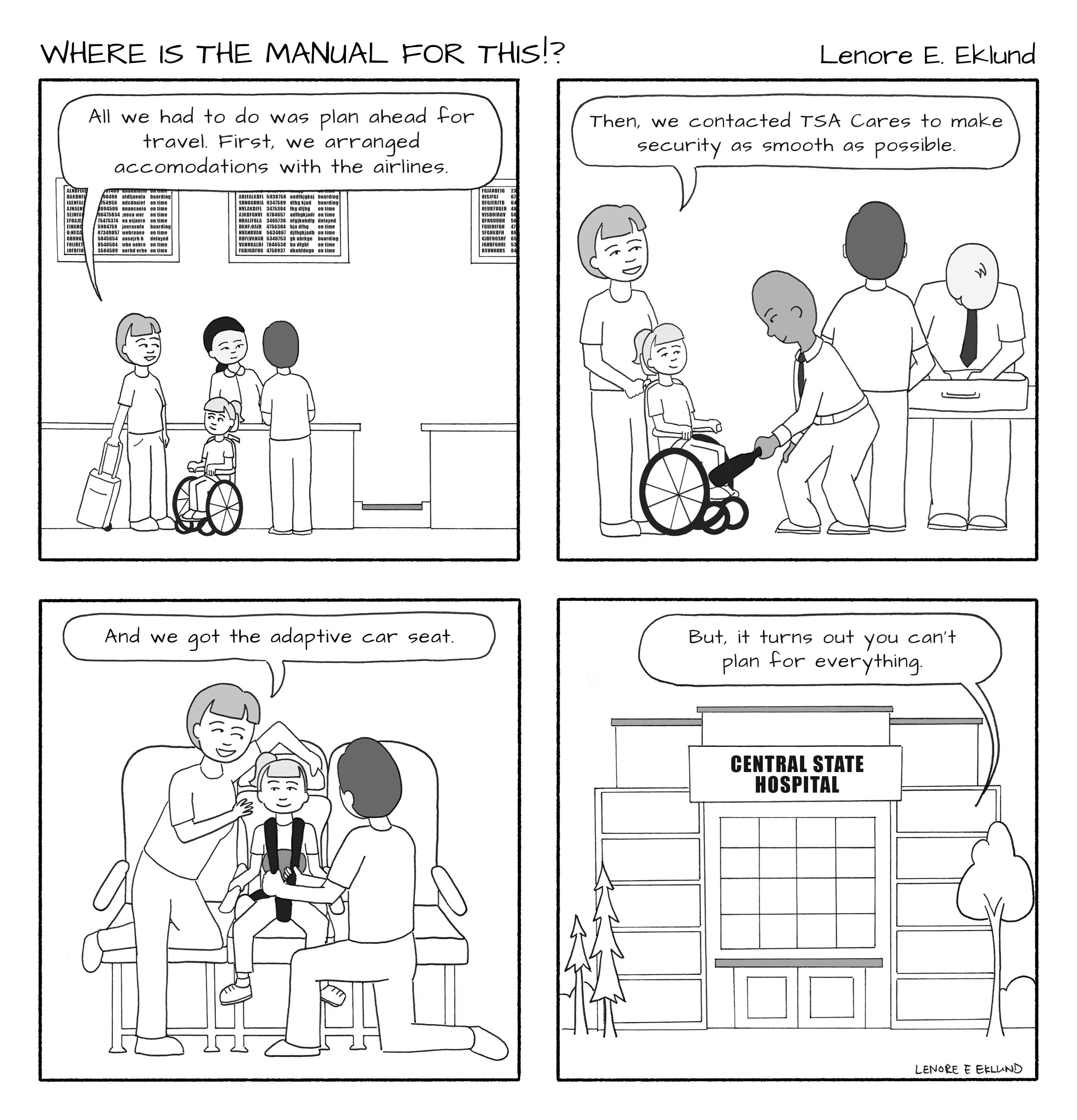
Our Medical Motherhood comic artist Lenore Eklund is back! She said this comic has been in her mind since the first quiet moment after her daughter’s emergency hospital stay on a summer trip.
There’s a lot we can prepare for. But the nature of medical motherhood is that things don’t often go according to plan.
Fortunately, we always have ways of expressing this unusual and unexpected life. Art can be healing in all forms — both for those who create it and those who see their own experiences reflected in it.
On the second Sunday of every month, we feature Where is the Manual for This?!, an editorial cartoon about the medical mom life from Lenore Eklund, who now has her own Substack!
Watch my presentation to the Oregon Senate Committee on Human Services
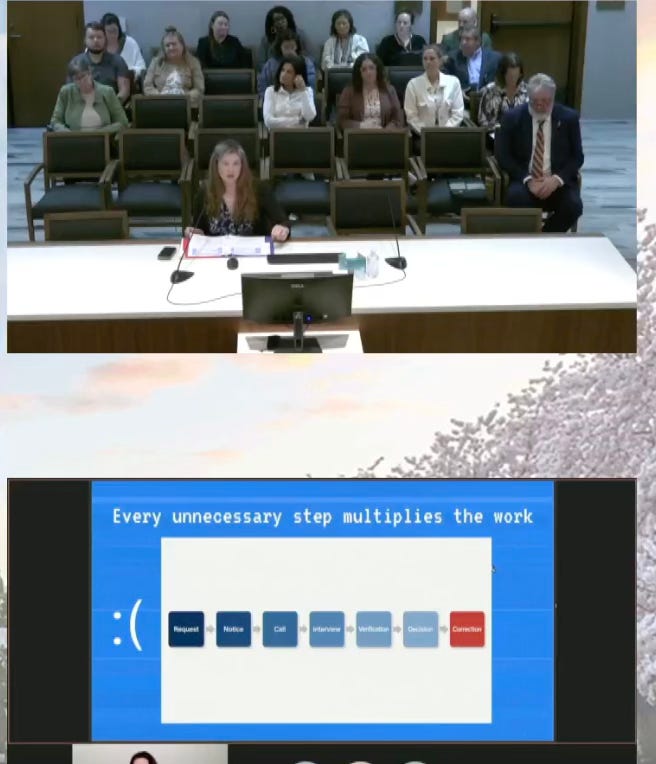
One thing that is unique about my perch here behind Medical Motherhood is that I get to see the wider policy landscape. I see arguments bandied back and forth across the political spectrum, as well as niche stories from around the world that most people don’t have delivered to them in their social media feeds.
So when advocacy I’ve been doing for a few years around the types of records my state demands and keeps for disabled Medicaid applicants came to a head a few weeks ago, I jumped at the chance to present on the topic to the Oregon Senate Committee on Human Services.
You see, as complicated and bureaucratic as Oregon’s Medicaid system is, it’s only going to get worse next year. The One Big Beautiful Bill Act, aka H.R. 1, is adding several hoops for Medicaid applicants to jump through. Many — like children, disabled people and caregivers — are supposed to be exempt from some of the biggest new requirements. But Deloitte — the company behind the IT systems used by half of American state governments to determine Medicaid eligibility — is charging enormous sums to change those systems. So, Oregon officials feel it’s just fine to just make all applicants go through the same process.
I disagree.
You can watch the 20-minute video of my presentation here or just peek at the (easy-to-understand!) slides here.
How is your state handling the rollout of HR 1’s new eligibility requirements? Are disabled people getting caught in the web as they have been in Indiana and Michigan?
If you’re working on Medicaid eligibility issues in your state, I’d love to compare notes.
Medical Motherhood’s news round up
Snippets of news and opinion from outlets around the world. Click the links for the full story.
• From NPR: “Special education head at Education Department abruptly resigns”
[…Kelly] Rogers, who has been overseeing the Office of Special Education and Rehabilitative Services (OSERS) since May, announced her departure less than a day before much of her staff were scheduled to move to the Department of Health and Human Services building in Washington D.C., according to internal emails reviewed by NPR.
[…]it is unclear who will serve in the role after she leaves on Sept. 11.
[…]On top of the staffing and physical changes to the Education Department, [parent advocate Chad] Rummel points out that the president's budget proposal for the coming fiscal year 2027 would cut over 80% of OSERS staff. He said if that proposal becomes reality, he has deep concerns for the rights of students with disabilities.[…]
• From ProPublica: “Vouchers Promise Students With Disabilities a Path to Private School. Parents Say That’s Not the Reality.”
[…]More than half of Utah’s counties have no private schools that take its vouchers for students with disabilities. In Georgia, 71% of counties have none. And in Louisiana last year, among about 350 private schools, only 14 reported enrolling a single child with a disability. Eight of those admitted five or fewer such students.
Even in Florida, with its urban centers and roughly $5 billion voucher programs, ProPublica found that more than a dozen counties have no private schools that serve kids with disabilities or have only one school with limited offerings. Our analysis of state data also shows that more than half of Florida’s private schools say they do not serve students with any type of disability.
“It’s touted that this program is an equalizer, and then people have choice,” said Jinny Kim, managing attorney at the Disability Rights Education and Defense Fund, a national civil rights and policy nonprofit that advocates for people with disabilities. “But then if you really look at the details, it’s not actually how it happens.”[…]
• From Nebraska Examiner: “Parents, professionals highlight errors in Nebraska assessment for developmentally disabled”
Just over a year after Nebraska launched a new system to assess Nebraskans with intellectual and developmental disabilities seeking Medicaid assistance, a group of parents gathered to inform state officials about the negative impacts the change has had on their families.
[…]One of the biggest flaws noted at Wednesday’s meeting was that the interRAI system lowered the funding of participants who live at home with their loved ones. [Parent advocate] Salber said this is considered “informal support” and is used to justify reduced aid.
Multiple parents testified Wednesday that their children’s funding tiers dropped because of this factor, though all said their needs are severe enough to require higher support.[…]
• From Atlanta News First: “Georgia school districts spend hundreds of thousands on special education legal battles”
Georgia school districts are spending hundreds of thousands of taxpayer dollars on legal battles to fight parents of disabled children over special education evaluations.
District records, uncovered by Atlanta News First Investigates, reveal proceedings have more than doubled costing both families and taxpayers.
[…]According to records obtained by Atlanta News First Investigates, Gwinnett County Schools spent more than $720,000 on legal fees to hire attorneys for due process proceedings from January 2023 to February 2026. The total does not include settlement agreements paid to families when disputes are resolved out of court.[…]
• From ID ED News: “The funding formula debate has a human cost”
Everyone in Idaho education policy knows the number: $100 million. That’s the gap between what state and federal funding provides for special education and what it actually costs Idaho school districts to serve disabled children.
[…]Idaho has among the lowest ratios of special education staff to students in the nation. Only Idaho and Ohio have fewer than 20 special education staffers per 200 students, compared to more than 60 in some states.
[…]In 2025, the Legislature rejected a $3 million proposal to help districts cover costs for students requiring full-time ASL interpreters or dedicated aides — the children with the greatest needs and the highest per-student costs. Three million dollars. Rejected by one vote. What passed instead was a $5 million catastrophic fund, accessible only after a district has already spent $30,000 on a single student and exhausted every other available resource including Medicaid — the same Medicaid benefits the Legislature spent that session attempting to cut for disabled Idahoans.[…]
• From Bloomberg Government: “Medicaid Cuts Leave Schools Pondering How to Serve Disabled Kids”
[…]Best known as the state-federal health insurance program for low-income and disabled Americans, Medicaid is also a significant funding source for special-needs services in K-12 public schools. And no state has cut Medicaid enrollment as aggressively as Indiana has, as states tighten eligibility requirements.
The state has seen the largest percentage drop in child health insurance enrollment of any state, losing more than 203,000 kids — or 23% — since January 2025, according to Georgetown University data. That figure includes children enrolled in both Medicaid and the Children’s Health Insurance Program, which covers kids whose families earn too much to qualify for Medicaid.[…]
• From My Bellingham Now (Washington): “Program for disabled children’s families seeking additional funding after budget cut”
A statewide support program for families of children with developmental disabilities will continue after weeks of uncertainty.
Washington’s Parent to Parent program has received a funding cut of just over 10% from the Department of Social and Health Services, but advocates say they’re relieved it wasn’t eliminated.
The program helps families navigate services and connects them with trained parent volunteers. Last year, it logged nearly 93,000 contacts with families statewide.[…]
• From The Virginia Independent: “Republican cuts will decimate caregiving in America, report says”
Federal cuts championed by President Donald Trump and congressional Republicans are endangering caregiving programs across the country, leaving states scrambling to support caregivers who could lose their jobs as well as the older individuals, people with disabilities, children and others who rely on their services, according to a new report from the Century Foundation.
The progressive think tank published its findings at the end of July in a report titled, “Care Matters: A 2026 Report Card on Care Affordability and Access.”[…]
• From U.S. News & World Report: “Parents, Advocates Split on U.S. Special Education Change”
More than 8 million American children with disabilities are starting the new school year with guarantees of a decent public education at their local schools and federal funding that helps pay for it.
But parents and advocates are split on whether a Trump administration move that transfers federal responsibility for special education from the Department of Education to the Department of Health and Human Services will help or harm students with disabilities.
[…]Fully endorsing the special education changes is Jeanne Allen, CEO of the Center for Education Reform, who says the Department of Health and Human Services is capable of handling special education and emphasizes that it did so before the education department was created.[…]
Medical Motherhood brings you independent, ad-free news and information each Sunday for raising disabled and neurodivergent children.
Free subscribers help this work reach more families. Paid subscribers make it sustainable. Get the newsletter in your inbox, give a gift subscription or become a paid supporter to help keep this resource available to everyone.
Not ready for a subscription but like what you read here? You can also buy me a coffee.
Follow Medical Motherhood on Facebook, Bluesky, X, TikTok, Instagram or Pinterest. Visit the Medical Motherhood merchandise store.
