

The Top Medical Motherhood Issues of 2025
Plus: Alabama settlement means more kids will be home for the holidays, Nebraska targets family caregiver income for cuts, and a Canadian palliative care center celebrates Christmas
It the time of year for reflection, where we take stock of where we have been and muse about where we are going.
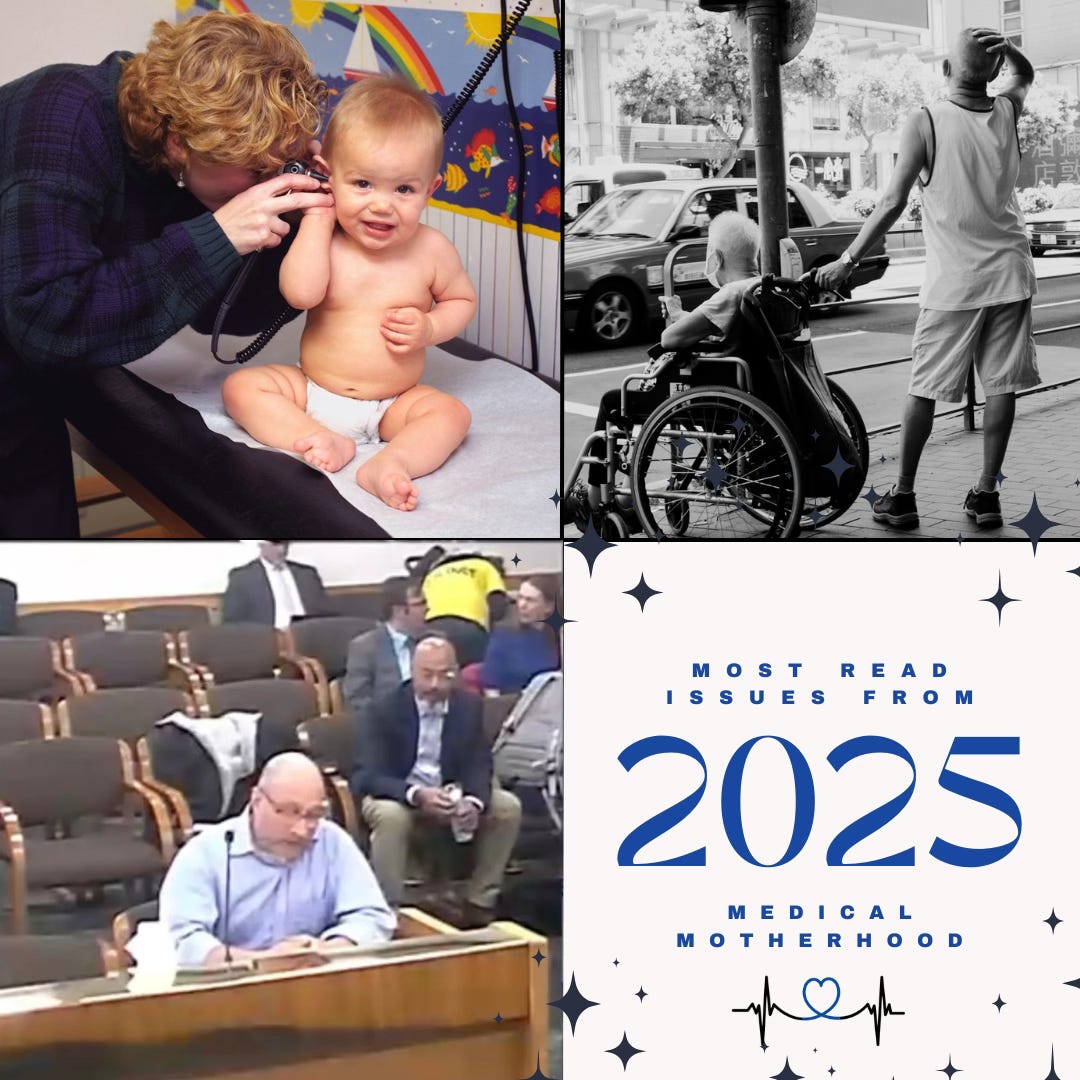
This is also reflected in the most-read Medical Motherhood issues of the year. All three of these issues garnered over 1,000 views, making them the top issues. In case you missed them, or in case you need a reminder, here they are again.
In January, I brought you the story of Tennyson Ross and his mom Calli Ross. Together, the pair were a frequent sight at the Oregon State Capitol as they lobbied for paid parent caregivers. Their plea took a particularly dramatic turn when a medical crisis and Calli’s quick, calm action showed state senators exactly the kind of care medical mamas have to be prepared for on short notice.
Crisis at the Committee: Why the Fight for Paid Parent Caregivers Can’t Wait

The members of the Oregon Senate Committee on Health Care won’t soon forget Tennyson Ross.
The scene made an impression, but ultimately Tensy’s Law — which would have expanded Oregon’s tiny paid parent caregiver program from 155 spots to more than 1,000 — failed to pass.
Soon after the state legislative session ended, on the federal level, Congressional Republicans passed the One Big Beautiful Bill, now often called H.R. 1. We are still figuring out the trickle-down effects of this new tax and spending law. However, there were a few things that were known at the time and a lot of fear-mongering from journalists who didn’t know how to interpret the dueling narratives. I unpacked all of that in the July 6 issue:
Fear and Loathing in Disability Services

Whew. Do you feel it? The media storm unleashed this week by the Trump Administration and the passage of the One Big Beautiful Bill Act has been intense. With my previous experience working in newspapers, it is clear to me how the combination of social media algorithms that elevate posts with a shock factor, the rush to…
More recently, I dove into how Oregon could react by cutting disabled kids services in the Dec. 7 issue. Spoiler alert: medical mamas across the country are going to have to fight to make sure states make the right call.
But that’s OK, because we have oodles of free time, right? Except, no, we don’t. Fortunately, the American Academy of Pediatrics this year formally recognized the role of parent-caregivers and their need for support. The AAP report underlined the need for paid family caregivers, telehealth appointments, physician compensation for care coordination and other family-friendly models of health care. Read more in the Aug. 31 issue:
Pediatricians Urge Better Support for Families Shouldering Home Care for Disabled Children

The American Academy of Pediatrics published a new clinical report on home health care for children, adolescents, and young adults with “complex medical needs.” While there are an estimated 15 million American children with some sort of disability or chronic health condition, children with medical complexity are the subset of the…
It has been a year of ups and downs. In 2026, I anticipate an even greater need for the public to understand Medicaid law and the rights and needs of disabled children and their families. I’ll do my small part to bring you news and information vital to this community, in a way that hopefully catches people’s attention without sliding into clickbait or fear mongering. Thank you for being with me through this journey.
I wish you and yours a very happy new year.
Medical Motherhood’s news round up
Snippets of news and opinion from outlets around the world. Click the links for the full story.
• From WOWT (Nebraska): “Proposed state cuts could eliminate care hours for families with disabled children”
Aaron Kuecker’s two daughters have cerebral palsy and need constant care. The family currently receives 112 hours a week of state-funded care, but proposed cuts would slash that to 40 hours.
The Kuecker family adopted 19-year-old Chitti and 10-year-old Saha from India five years ago. Both daughters have cerebral palsy, and Chitti has a rare epilepsy called Lennox-Gastaut Syndrome.
[…]Aaron Kuecker works as a full-time teacher with Omaha Public Schools while Katie stays home with the children. The care they need goes beyond the 112 hours they already receive.
“That leaves us with a decent chunk of time that is considered unpaid labor… or Katie would have to go and get a job,” Aaron Kuecker said.
By cutting their hours down to 40, the Kuekers could lose close to $1,000 of income every month.
“Do we have to sell our house and move somewhere else? How do we find a thousand dollars?” Aaron Kuecker said.
The Kuekers started an online petition that has gathered over 1,600 signatures. [As of this publication, over 2,400.] They are among many families trying to influence the decision.
“Hopefully the DHHS will listen and reconsider this,” Aaron Kuecker said.[…]
• From Alabama Political Reporter: “Alabama settles lawsuit over institutionalizing disabled children”
A 2021 lawsuit against the state of Alabama over the state’s practice of unnecessarily institutionalizing children with mental health disabilities in psychiatric residential treatment facilities, PRTFs, appears to be coming to a close after a preliminary settlement agreement was reached late last week.
The lawsuit, brought against the state by the Alabama Disabilities Advocacy Program, Children’s Rights and the Southern Poverty Law Center, SPLC, accuses the Alabama Department of Human Resources, DHR, of violating the Americans with Disabilities Act, ADA, by “isolating children in highly rigid and often dangerous settings instead of meeting their mental health needs in a loving home or community-based setting.”
[…]per the terms of the settlement, Alabama will be required to institute standardized assessments for children at risk of PRTF placement, requiring physician certification of need in 95 percent of cases. Additionally, the state agreed to implement six-month quality reviews to ensure children’s care plans meet professional standards and to place children in community-based and family-like placements, including kinship care and therapeutic foster care, when appropriate. Meanwhile, the state will cap congregate care in shared living facilities at no more than 7 percent of children in state custody.
[…]“This agreement is a long overdue win for children and families across Alabama,” said Lindsey Frye, senior staff attorney at Children’s Rights. “Children with disabilities deserve to grow up in safe, loving family homes, not locked away in institutions. For too long, Alabama’s overreliance on psychiatric facilities has inflicted lasting harm.[“…]
• From CTV News (Canada): “Christmas joy for children receiving end-of-life care in Montreal”
[…]Le Phare, located in Montreal, serves approximately 200 families and has 12 beds on site to provide respite for parents or to welcome them when their child is receiving end-of-life care.
[…]For many of these children, their life expectancy is unknown because their disease is rare.
[…]An employee of Le Phare who adopted a child with multiple disabilities three years ago wished to remain anonymous, as this is a personal matter. Although she has a background as a nurse and has been “immersed in multiple disabilities” since she was young, the reality of caring for a severely disabled child was very different from what she had anticipated.
Her child does not have a degenerative diagnosis, but due to his neurological fragility, he is more prone to complications. In particular, he has epilepsy, which affects his cognitive, motor and socio-emotional development.
At Christmas, travelling from one family to another is exhausting, says the mother.
“We go left and right, but that means lugging around a wheelchair and all the protocols in case they start to feel unwell. It’s like moving house, even for a Christmas party. Is it worth it? I’ll do it anytime, but it takes a lot of organisation,” she says.
[…]She remembers one evening, on Dec. 31, when the employees counted down the New Year in the room of a dying little boy with his family (at their request).
“As much as these moments can be difficult for families, they are also moments that families cherish deeply. They take what they can get. It can be emotional knowing that it’s the last Christmas. At the same time, they have that last Christmas, so they take everything they can to enjoy it. It’s a privilege as an employee to be able to share these intimate and beautiful moments with families,” she said.[…]
Medical Motherhood brings you quality news and information each Sunday for raising disabled and neurodivergent children. Get it delivered to your inbox each week or give a gift subscription. Subscriptions are free, with optional tiers of support. Our paid subscribers make this work possible! Not ready to subscribe but like what you read here? Buy me a coffee.
Follow Medical Motherhood on Facebook, Bluesky, X, TikTok, Instagram or Pinterest. Visit the Medical Motherhood merchandise store.
Keep going, Shasta. What you're doing -- with tenacity, and with grace -- is making a difference. I'm quite sure of that.