


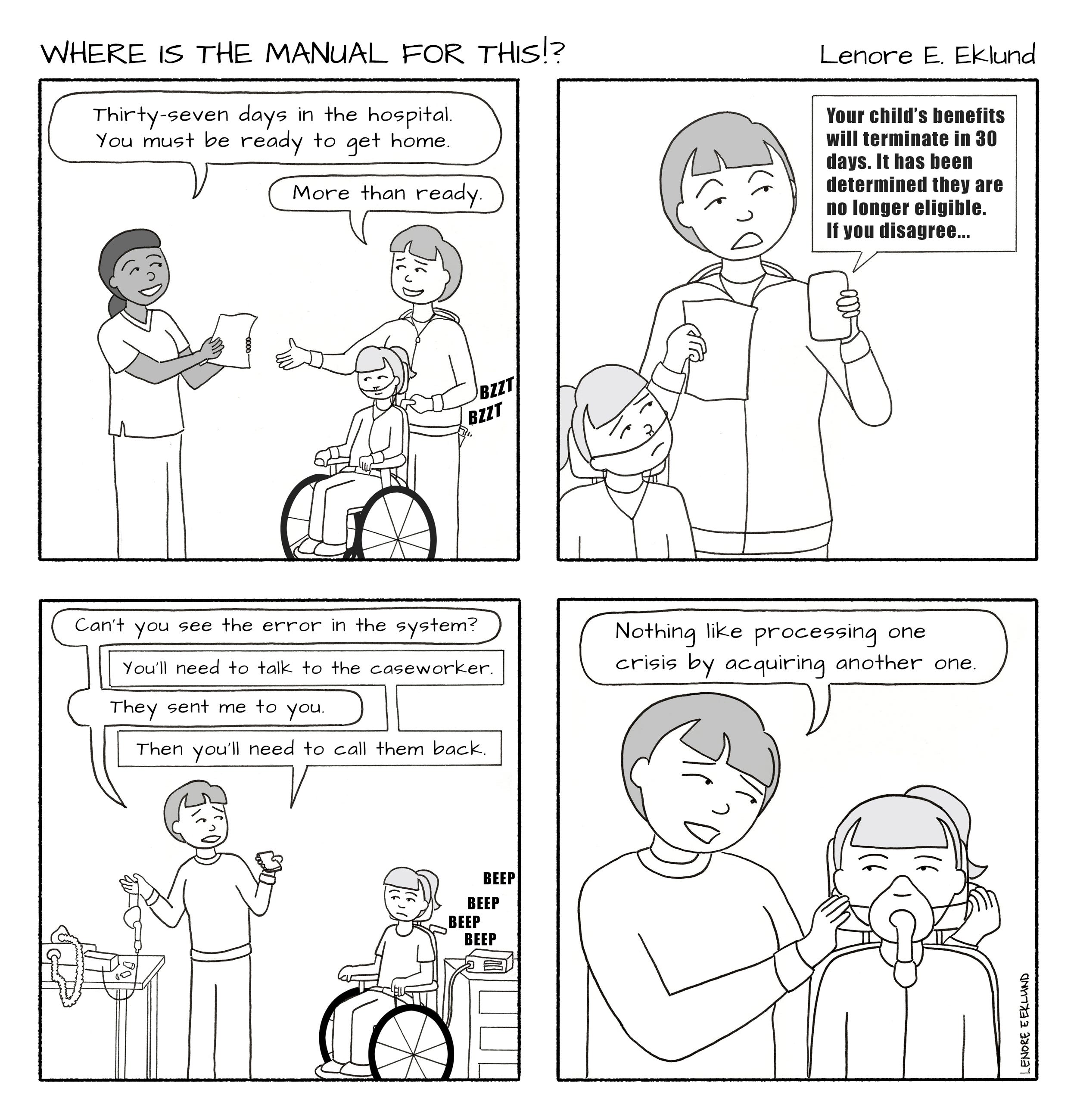
From crisis to crisis! Some days feel like that. So very frustrating!
As this week’s comic shows, getting home from the hospital doesn’t necessarily mean the crisis is over. Sometimes there’s a new one waiting in the mail: Your child’s Medicaid is about to end, and no one seems able to fix it.
That’s why I’m concerned about the expanded Trump accounts for kids.
Rolled out in July as an opt-in program, these investment accounts offer $1,000 in federal seed money for U.S. citizens born in 2025–2028. Older children could have tax-deferred accounts too, but without that federal deposit. The idea is to help children save for the future.
Great idea.
The problem is how those savings interact with disability benefits — and who is responsible for making sure families don’t lose them.
On Oct. 1, the U.S. Treasury announced that every eligible child under 18 with a valid Social Security number now has a Trump account. Parents or guardians must claim the account to manage it, but the government has already opened it. Families cannot opt out of having the account created, and leaving it unclaimed doesn’t make it disappear. The account stays open, and any money in it remains invested.
There is an opt-out option, but according to the program’s account-closure guidance, it only stops future participation in donor gifts of stock. It doesn’t close the account or remove the money or stock already in it.
For families navigating disability services, an investment account isn’t always a simple gift. SSI and Medicaid eligibility pathways limit the assets a person can own. Not all Medicaid coverage has an asset test, but for people whose coverage does, saving for the future can put essential benefits at risk.
Congress created ABLE accounts in 2014 specifically to address this problem. They allow eligible people with disabilities to save without those savings counting against means-tested benefits. For SSI, the first $100,000 is excluded from the asset limit.
Trump accounts have a more limited protection. Social Security does not count them as an SSI resource before January 1 of the calendar year the child turns 18. Beginning that January, however, the available balance becomes countable and could put SSI eligibility at risk. Depending on the person’s eligibility pathway, Medicaid could be affected too.
There is a way to protect the money: Roll it into an ABLE account. But the special rollover is available only during the calendar year the child turns 17.
So now families have another account to track, another rule to understand and another deadline to meet — even if they never asked for the account and would rather decline it.
Why not build in lasting protection for disability benefits, instead of making families responsible for preventing another crisis?
I worry that once again this administration has not taken disabled children’s needs into… wait for it… account.
On the second Sunday of every month, we feature Where is the Manual for This?!, an editorial cartoon about the medical mom life from Lenore Eklund, who now has her own Substack!
Medical Motherhood’s news round up
Snippets of news and opinion from outlets around the world. Click the links for the full story.
• From Disability Scoop: “Trump Accounts Could Put SSI At Risk”
Special savings accounts that recently debuted may be a boon for families, but experts warn that without careful planning, they could compromise access to disability benefits.
The newly created Trump Accounts, which became available in July, allow families to establish a tax advantaged investment account for their kids.
[…]However, experts are warning that the free money could come with a downside for children with disabilities.
[…] The law allows funds for children with disabilities to be rolled over from a Trump Account to an ABLE account, but only during the year in which the beneficiary is age 17.
[…Kathleen] Romig with the Center on Budget and Policy Priorities said the conundrum highlights the need for Congress to raise the SSI asset limit and to adjust the law to allow families to transfer Trump Account balances to ABLE accounts at any point.
• From NPR: “How the system failed us: Former foster youth tell their stories”
[…]Most children in foster care live with families, with relatives or with other foster parents. But about 10% of disabled kids in foster care live in group homes and institutions, compared to just 4% of those without disabilities.
An NPR investigation found children with disabilities, including physical and behavioral health disabilities, are the largest group that goes into foster care — and they have the worst outcomes.[…]
• From California Health Report: “Analysis: Children With Disabilities Have a Right to Health Services in School. Here’s a Guide”
[…]Disabled children have a right to a free and appropriate public education. I’m making an intentional choice to use the word “disabled” to talk about children who need care during the school day. Many families use words like “special needs” to talk about children with disabilities. But disability is a word that is defined by state and federals laws that comes with rights. When families ask school districts for accommodations that will make it safe for their child to attend school, they’re not asking for the school to do a nice thing — they’re asking for the school to demonstrate how they plan to provide a legally required service.[…]
• From Arkansas Democrat-Gazette: “Families of Arkansans with disabilities testify to state lawmakers about waitlist for in-home aid
Families of disabled Arkansans waitlisted for critical in-home services testified alongside officials from the state Department of Human Services at a legislative hearing Friday, expressing very different opinions on how the Community and Employment Support Waiver program is working.
[…David] Watson said when he found out that people on the waitlist could begin to receive supportive living services starting in January, “I got excited” and he immediately called Easter Seals.
The nonprofit said “they have no idea how that money will be implemented,” he said, so as of now [his daughter Mariah, who has been on the CES waitlist for nearly three years] still needs to be in the CES waiver program to get those services.
“She’s not a number, she’s my daughter,” Watson said, tearfully. “How do we build a system in which disabled Arkansans can actually get services?”[…]
• From USA Today: “A 7-year-old boy needs disability care. These parents united to help”
Surrounded by hundreds of other parents raising children with disabilities, Tamerah Cooper was no longer alone.
[…]Cooper joined the Little Rock rally Sept. 16 to demand state officials fully fund programs that allow people with disabilities to live at home as required by federal law. The Americans with Disabilities Act and a 1999 U.S. Supreme Court decision affirmed disabled people have a right to care that lets them stay in their community rather than being forced to live in medical facilities.
And yet, more than 2,400 people in Arkansas – and 650,000 nationwide – appear on waitlists for those Medicaid services.[…]
• From WKYT: “Kentucky families of children with disabilities say they’ve lost Medicaid coverage after federal changes”
Two Richmond mothers say their children with disabilities have lost Medicaid coverage following federal changes to the program.
[…Megan] Gammell said that after the federal spending bill pushed by the Trump administration passed last summer, she has had to fight to get her daughter’s coverage back three times.
[…]“She was on life support, and I remember the social worker coming and talking to me and telling me that her insurance had dropped her. We didn’t think that she was going to survive, and they were dropping her due to Medicaid changes and cuts,” Gammell said.[…]
• From World: “Let’s build up American families” (Opinion)
I used to believe, as many conservatives still do, that our government is not in the business of subsidizing families to have kids. But after five children, including one born profoundly disabled, I’ve changed my tune. Apparently, so has the White House. The Trump administration recently unveiled plans to support married, stay-at-home parents by expanding existing Child Care Development Fund benefits that currently support working parents.[…]
• From The Independent (U.K.): “Proposed £12bn cut to disability benefits for children called ‘shockingly cruel’”
[…]The work from Policy Exchange calls for eligibility for the Child Disability Living Allowance (DLA) case load to be restricted to cut £11.9bn from welfare spending over four years.
Child DLA is the main health and disability benefit for under-16s, claimed by parents of around 915,000 children.
[…]Policy Exchange researchers add that 86 per cent of claimants are now reporting learning difficulties, behavioural disorder and hyperkinetic syndrome, calling for a restriction of eligibility around these conditions. They recommend this criteria be reviewed every three years to keep spending at “sustainable levels”.[…]
• From New African: “Two worlds of disability support”
[…]Wela Elmahi, a Sudanese special needs educator and music therapist now based in Dubai, has seen the situation from both sides of the divide – as a young professional trying to build a career in a Sudanese system with few resources, and later as a practitioner in one of the world’s more heavily resourced systems in the United Arab Emirates.
[…]That gap reflects deliberate policy choices. The UAE has built a legal and institutional architecture around what it calls ‘People of Determination’, anchored in the Federal Law of 2006. The National Policy for Empowering People of Determination rests on six pillars, including health and rehabilitation, education and social protection.
[…]Families in Sudan face a starkly different reality, […] many parents are forced to keep children at home, without professional guidance of any kind, not because they lack the will to help their children, but because the system offers them almost nothing to work with.[…]
Medical Motherhood brings you independent, ad-free news and information each Sunday for raising disabled and neurodivergent children.
Free subscribers help this work reach more families. Paid subscribers make it sustainable. Get the newsletter in your inbox, give a gift subscription or become a paid supporter to help keep this resource available to everyone.
Not ready for a subscription but like what you read here? You can also buy me a coffee.
Follow Medical Motherhood on Facebook, Bluesky, X, TikTok, Instagram or Pinterest. Visit the Medical Motherhood merchandise store.
Thank you, Shasta, for another week's round-up of thought provoking articles. I appreciate you.