
Trying to Look Like We Don't Need Help to Get Help
Plus: Idaho debates restoring paid parent caregivers, a New Jersey ombudsman calls out government indifference, and England proposes major changes to special-education support.
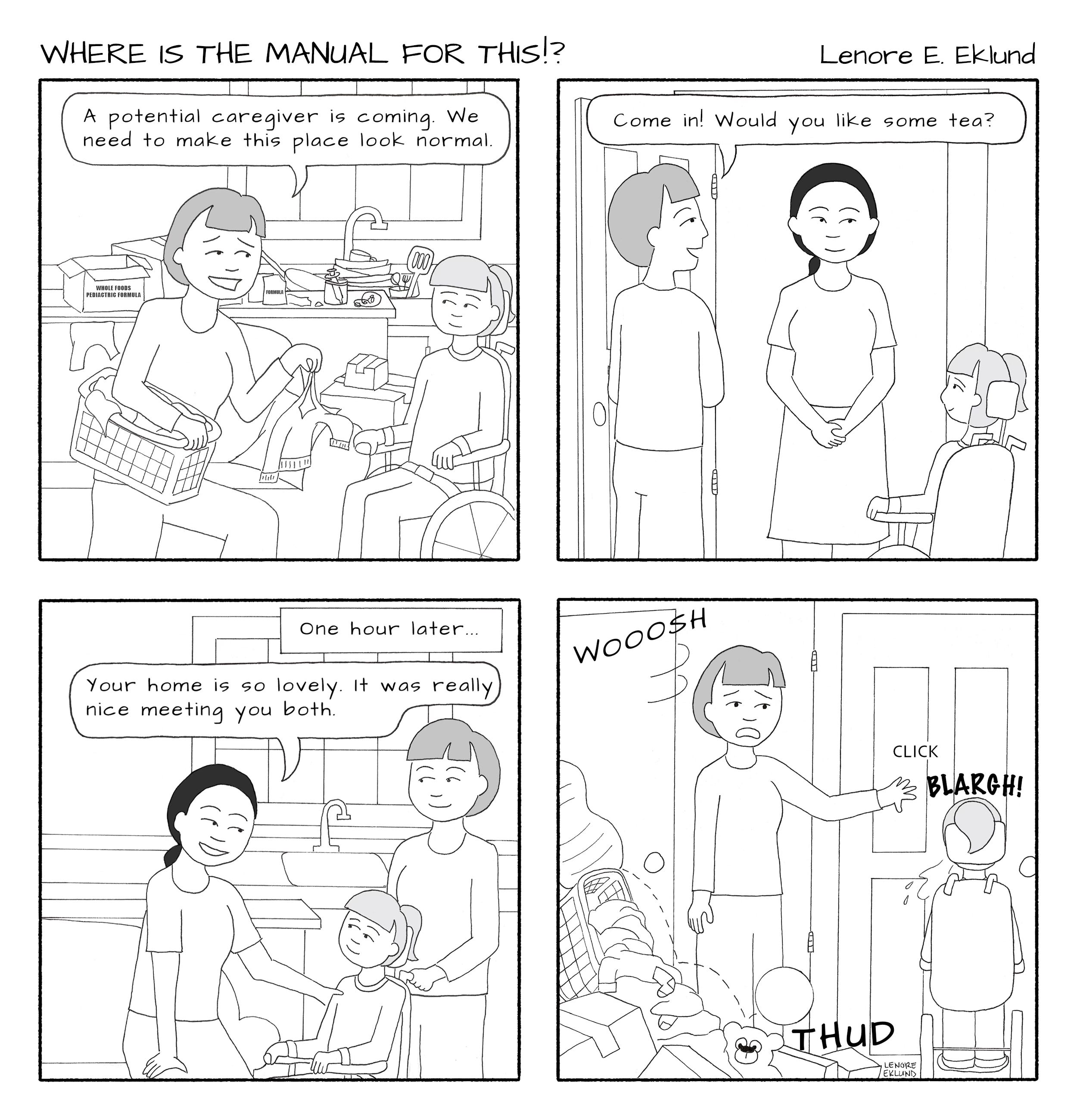
Why does it feel like we have to look like we don’t need help in order to get help? I’m just as guilty of putting on a good face when potential caregivers come for a meet-and-greet. However, now that I think about it, for what turned out to be one of our best long-term caregivers, I remember blurting out that I wasn’t high or anything, I was just really, really tired. She laughed at that and I think it may have been one of the reasons she took the job. She could see how badly I needed the help. What about you? Do you clean up or let it all hang out?
On the second Sunday of every month, we feature Where is the Manual for This?!, an editorial cartoon about the medical mom life from Lenore Eklund.
Medical Motherhood’s news round up
Snippets of news and opinion from outlets around the world. Click the links for the full story.
• From KTVB 7: “Idaho lawmaker pushes to restore program that pays parents to care for children with disabilities”
An Idaho lawmaker is pushing to restore a state program that paid parents and spouses to care for their loved ones with severe disabilities after the Department of Health and Welfare ended it last year.
House Minority Leader Ilana Rubel, D-Boise, told KTVB the program’s termination has left some of the state’s most vulnerable families without options, unable to find outside caregivers and unable to be compensated for providing the care themselves.
[…]During the COVID-19 pandemic, Idaho began paying parents and spouses to serve as the caregiver for their child or partner with disabilities at the same hourly rate the state pays third-party agencies to provide care for.
[…]But in 2025, the Department of Health and Welfare ended the program, citing concerns over overuse and potential fraud and abuse.
[…]Now, Rubel is pushing legislation to bring the program back with guardrails she told KTVB will address the state's concerns. Her bill would limit participation to 1,000 families and cap paid caregiver hours at 25 per week for parents or spouses, with new Department of Health and Welfare staff dedicated to monitoring for fraud, waste and abuse.
[…]With no outside help available and no compensation for doing the job themselves, Rubel said many families are trapped.
[…]"I really worry about the financial duress that they're being put under, and whether some of them may be losing their home soon if we don't act," Rubel said.[…]
• From NJ.com: “This N.J. official drove 148,000 miles to help families with disabled loved ones. What he found was heartbreaking.”
Paul Aronsohn had just submitted his first annual report as the new Ombudsman for people with developmental disabilities when he was summoned to a meeting with a senior member of Gov. Phil Murphy’s administration in early 2019.
The report described New Jersey as a ‘tale of two systems, one that is good and one that is not good,’ that is ‘in need of fixing because lives, frankly, depend upon it.’”
Aronsohn said it was immediately clear the Murphy administration was not pleased with his candid report.
“Paul, what are you doing? You’re not supposed to be an advocate,” he said the senior official told him. After a moment of stunned silence, Aronsohn quickly recovered, remembering Murphy had described him as “the administration’s lead advocate” for people with disabilities in the press release announcing his appointment in April 2018.
[…]He tells this story because it offers a glimpse into what the job required. He had to be the fervent voice on behalf of thousands of people with disabilities who deserved more than they were getting from the state. And, he would have to be the rational arbiter needed to establish a rapport with state officials and members of multibillion-dollar industry that provides housing, supervision, employment and other vital services to disabled people.
[…]“We work very closely with families who come to us. We get emotionally invested. In that sense, it has been the best job,” Aronsohn said. “On the other hand the indifference we encountered on a regular basis — it was infuriating and heartbreaking.”
He also offered specific advice for Gov. Mikie Sherrill’s administration, which will appoint his successor:
Tear down the “wall around state government” that keeps officials far from the daily reality of how stressful it is to care for people with disabilities and the frustration of navigating an enormous bureaucracy.
Appoint people to the state departments of Human Services and Children and Families who know what it’s like to live with autism, cerebral palsy and other disabilities.
Require these officials to speak directly with clients and their families.
“We encounter people inside and outside of state government who don’t have that sense of mission or that sense of urgency that should be a prerequisite for any of these jobs,” Aronsohn said.[…]
• From Sky News (United Kingdom): “Shake-up of support for children with special needs and disabilities unveiled”
The government has unveiled sweeping plans to reform support for children with special educational needs and disabilities (SEND) in England’s schools.
Under the proposals, the number of pupils receiving an education, health and care plan (EHCP), which sets out the level of help a young person is legally entitled to, will start falling each year from 2030, according to official projections.
Instead, around one in eight SEND children currently on an EHCP will transition to new plans between 2030 and 2035.
While the percentage of pupils with an EHCP is predicted to keep rising until 2029/30, the education department has estimated it will drop to around 4.7% by 2034/35 - down from 5.8% in 2025/26.
Education Secretary Bridget Phillipson said children with the most complex needs would keep their support plans as part of the reforms, which are set to come into force from the end of this decade.
She also insisted the new system would “take away that fight that so many parents” face in accessing support.
Children will also be allowed access to earlier support as part of a £4bn investment in the SEND system in England to make it more inclusive, Ms Phillipson said.
[…But] Anna Bird, chair of the Disabled Children’s Partnership, said it was “deeply concerned about plans to restrict access to EHCPs to ‘most complex needs’, while leaving out which children it considers to have complex needs”. […]
Medical Motherhood brings you quality news and information each Sunday for raising disabled and neurodivergent children. Get it delivered to your inbox each week or give a gift subscription. Subscriptions are free, with optional tiers of support. Our paid subscribers make this work possible! Not ready to subscribe but like what you read here? Buy me a coffee.
Follow Medical Motherhood on Facebook, Bluesky, X, TikTok, Instagram or Pinterest. Visit the Medical Motherhood merchandise store.


