



And now it’s time for a game of Whose Feeding Pump Is It, Anyway?
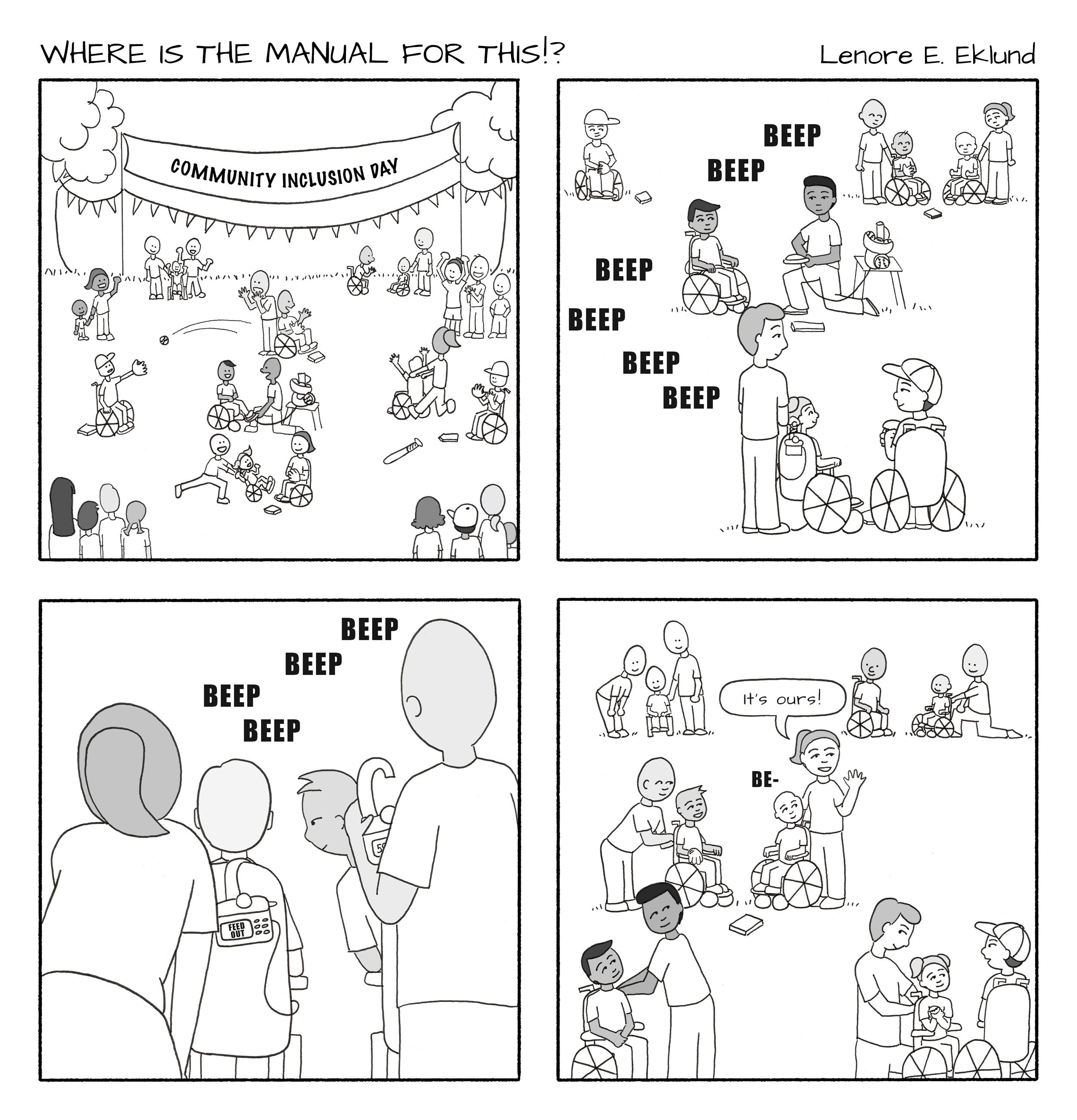
I have definitely been in this situation. Have you? My favorite thing in a big gathering of disabled children is watching families share tube food and lend out syringes just as off-handedly as they would snacks or silverware. It takes a village after all — and for our kids, a very unique village.
Which brings me to my next announcement. If you are in the Portland area, Little Lobbyists Oregon is hosting a kid-friendly community advocacy training on Thursday, Aug. 13 at the McMenamins Kennedy School Theater.
We have reserved this cozy theater lined with comfortable couches and are providing lunch and an optional free movie afterwards. This will be a fun, informative and joyful way to prepare for what’s coming in 2027.
If you read this newsletter, you know that there’s a lot of scary news out there: from declining Medicaid funding, to changes to special education and threats to the services disabled people need to live at home.
But the good news is that ordinary people like you and me organized to create those programs in the first place, so all it takes is our community coming together again. Bonus: we might even be able to design a better, more functional system!
Don’t wait until it’s too late. The time to change things for the better is now, before our children lose their rights and services.
Register here: Little Lobbyists Oregon Advocacy Training Lenore Eklund, the cartoonist, and I will be there with our kids — along with many other advocates — and we will all get to play the Whose Feeding Pump Is It Anyway? game together!
On the second Sunday of every month, we feature Where is the Manual for This?!, an editorial cartoon about the medical mom life from Lenore Eklund, who now has her own Substack!
Medical Motherhood’s news round up
Snippets of news and opinion from outlets around the world. Click the links for the full story.
In case you missed my July 5 announcement, I took last Sunday off as part of the two weeks every year that I take a vacation from producing this newsletter. The rest of the news world, however, did not take a week off, so there are even more stories than usual! I have compressed the amount of excerpts in an effort to get the maximum number of worthy and relevant links in. Enjoy!
• From CharityToday (United Kingdom): “Summer digital festival for disabled children returns”
THIS August, disabled or seriously ill children and their families can learn to code, animate and create their way through summer with national disability charity Family Fund’s Discover Digital summer festival.
Offering fun and fully accessible creative workshops particularly designed for disabled and seriously ill children, the festival can be joined live or, for the first time this year, on-demand, in their own time and at their own pace.[…]
• From The 19th: “The nation’s largest school system is expanding special education for its youngest learners”
[…]The nation’s largest school system is investing $67.5 million in special education as families across the country fear the needs of their children with disabilities will go unmet amid the federal Department of Education’s continued dismantling.
In New York City, young learners will be able to participate in three programs designed specifically for students with autism that were previously only available to K-12 students.[…]
• From News from the States: “400 sick, disabled kids get second reprieve in Tennessee plans to report them to immigration office”
A Nashville judge has extended an order preventing Tennessee Department of Health officials from sharing identifying information about 400 sick and disabled kids with a state agency that collaborates with federal immigration enforcement.
It is the second reprieve for children enrolled in Children’s Special Services, a safety net program for sick children who need ongoing and — in some instances — life-sustaining care since last month, when the health department sent out notices spelling out immigration status reporting was a condition of continued care.[…]
• From GearJunkie: “He Built a Hiking Cart for His Disabled Daughter. Now It’s Keeping Families on the Trail”
[…]Wilde would eventually name his concept the Cascade Tandem Hiking Cart. It’s sort of like a simplified, one-wheeled rickshaw. At the front is the Frame and Harness, which ensures that only 25% of the rider/cart’s weight is on the carrier’s back. This harness includes trekking poles for forward motion, but they also double as stationary legs when the wearer needs to detach and rest.[…]
• From CPR News (Colorado): “Mothers caring for children with developmental disabilities worry as ‘unfair’ cuts to Medicaid take effect”
With the budget in crisis, state lawmakers capped the number of hours a week a person providing care to someone else, often a family member, can be reimbursed.
A series of phased in cuts started taking effect this month and impacted families expressed deep apprehension about what the coming months will bring.[…]
• From NC Newsline: “NC’s childcare crisis disproportionately affects disabled kids. A lawmaker says it’s time for change”
[…]Last week, the legislature passed a long-awaited state budget that included two key goals of the I/DD caucus. It spends $21.3 million per year for higher pay for direct-support professionals who provide in-home services and health care to people with disabilities. It also allocates $70.8 million to increase Medicaid funding for programs that offer community and in-home resources for disabled people who might otherwise be institutionalized.
[Zack] Hawkins, [a leader in the state legislature’s I/DD caucus] said that in the next legislative session, he hopes to tackle the challenges families with I/DD kids face in finding and maintaining affordable childcare.[…]
• From The Las Vegas Review-Journal: “Las Vegas Down syndrome self-advocacy program to expand nationwide”
[…]Gudiel’s Empower program focuses on transitional readiness to address what she described as lack of support for individuals with Down syndrome when they are progressing from their teenage years into adulthood.[…]
• From DisabilityScoop: “White House Wants To Make It Harder For People With Disabilities To Sue Federal Agencies”
[…]In court filings, attorneys with the Department of Justice now claim that people with disabilities don’t have the right to sue federal agencies under Section 504.
[…]Disability advocates say this argument is out of step with Supreme Court precedent and that the federal government itself has frequently made the opposite argument in previous court cases.[…]
• From KFDX: “Texas charity helps families of children with disabilities”
[…]Masonic Children and Family Services of Texas provides financial assistance to families who may not qualify for other forms of aid but still struggle to afford therapies, medical equipment and other essential services.
[…]Awad said the assistance from Masonic Children and Family Services of Texas has made a significant difference for her family and believes the organization has done more to help them than the state has. She said she will continue advocating for better care and resources for children with disabilities.[…]
• From 12 News: “Arizona students with disabilities fuel rapid growth in billion-dollar ESA voucher program”
A 12News investigation found the number of special education students receiving Empowerment Scholarship Accounts has tripled in four years, with several families receiving more than $30,000 annually.
Arizona’s Empowerment Scholarship Account program was created to give children with disabilities access to educational services that public schools could not provide.[…]
• From The New York Times: “An Autism Breakthrough, or an Illusion? The Fight Over Assisted Spelling”
[…]Proponents of assisted spelling say it has improved the lives of thousands of nonspeakers, some of whom have used it to write memoirs or obtain graduate degrees. Yet despite the potentially profound implications of these communication methods, there has been remarkably little scientific research evaluating them. Citing the risk that the person holding the letter board may influence the messages, and a history of such abuses with prior assisted communication methods, many medical groups have cautioned against them.
All of this has led to a growing debate dividing autistic people, families and the scientific community.[…]
• From the Associated Press via PBS News: “Trump's actions signal a move toward institutionalizing people with disabilities, advocates warn”
[…]Last month, the Department of Education announced it would shift oversight of special education to the Department of Health and Human Services, led by Robert F. Kennedy Jr., whose comments on the limits of disabilities such as autism have drawn sharp rebukes from advocates and lawmakers.
Meanwhile, after a White House push to police homelessness, the Department of Justice released guidance that lowered the barrier to institutionalizing any person with a disability.
Taken together, the actions signal a worrying return to a reality where people with disabilities are pushed to the margins of society, advocates said.[…]
Medical Motherhood brings you independent, ad-free news and information each Sunday for raising disabled and neurodivergent children.
Free subscribers help this work reach more families. Paid subscribers make it sustainable. Get the newsletter in your inbox, give a gift subscription or become a paid supporter to help keep this resource available to everyone.
Not ready for a subscription but like what you read here? You can also buy me a coffee.
Follow Medical Motherhood on Facebook, Bluesky, X, TikTok, Instagram or Pinterest. Visit the Medical Motherhood merchandise store.
I'm pumped for the advocacy training!